Guilt and Boundaries: Why Saying No Feels So Wrong
Why setting boundaries triggers guilt, why that guilt isn't a sign you did wrong, whether boundaries are selfish, and how to hold a limit through the guilt.

You finally set the boundary. You said no, asked for space, declined the request — and instead of the relief you hoped for, a wave of guilt arrived. Now you're replaying it, wondering if you were too harsh, fighting the urge to take it all back. If doing the healthy thing leaves you feeling like you did something wrong, you've run into one of the most common and most confusing parts of having boundaries.
This is a guide to guilt and boundaries: why limits trigger guilt, what that guilt actually is, and how to hold a boundary even when it feels wrong.
Why setting boundaries triggers guilt
For many people, a boundary and a stab of guilt arrive together, almost automatically. The reason is usually history. If you learned, growing up, that your role was to keep others happy — that love or peace depended on you being accommodating — then your nervous system tagged putting yourself first as something dangerous, even bad. So when you set a limit, an old alarm goes off: you've done something wrong, fix it. The guilt isn't responding to the present reality; it's running an old program.
The guilt isn't a sign you did something wrong
Here's the crucial reframe: guilt feels like evidence, but it isn't. Healthy guilt shows up when you act against your values — when you've genuinely hurt someone. Boundary guilt is different. It shows up when you act against an old rule — always say yes, never disappoint anyone — not against a value. You can feel intensely guilty and have done nothing wrong at all. The feeling is real; the verdict it's delivering is false.
Why boundary guilt is really a withdrawal symptom
A more accurate way to understand boundary guilt: it's a kind of withdrawal symptom. If you've spent years over-giving and self-erasing, the first boundaries will feel wrong precisely because they're unfamiliar — the way any change from a deep habit feels wrong at first. The discomfort isn't a signal to stop; it's a sign you're doing something new. As boundaries become normal, the guilt fades. It was never proof of wrongdoing — just proof of change.
Are boundaries selfish?
This is the fear underneath the guilt: that having limits makes you selfish. It doesn't. Selfishness is disregarding others entirely; a boundary is simply including yourself in the group of people who matter. Caring for your own limits is what lets you keep caring for others without burning out or quietly resenting them. A boundary isn't taking something from someone — it's declining to abandon yourself, and there's nothing selfish about refusing to disappear. (If guilt is a constant in your life well beyond boundaries, there's a fuller guide to guilt and self-blame.)
How to hold a boundary through the guilt
You don't have to wait for the guilt to disappear before you keep your boundary — you only have to stop letting it run the show.
Expect it, and name it
Knowing the guilt is coming takes some of its power. When it arrives, name it: this is boundary guilt, not proof I did wrong.
Don't act to make it stop
The guilt will push you to apologise, over-explain, or cave. Letting it be present without obeying it is how you teach your nervous system that the boundary is safe.
Let the other person have their feelings
You're not responsible for managing someone's disappointment. They're allowed to feel it; you're allowed to hold your line anyway.
Meet yourself with kindness
Boundary guilt responds far better to warmth than to self-criticism. Speaking to yourself gently — the way you would to a friend doing something brave and hard — helps the feeling pass.
The fuller picture
The wave that arrives after a boundary carries one message: this guilt proves I did something wrong — I was selfish, I should take it back. It feels true because guilt usually does mean wrongdoing, and this guilt is every bit as intense as the real kind.
But there are two different guilts wearing the same face. Healthy guilt shows up when you act against a value — when you've genuinely hurt someone. Boundary guilt shows up when you act against an old rule — always say yes, never disappoint anyone, keep everyone comfortable. You can feel it at full volume and have done nothing wrong at all, because the alarm isn't reading the present; it's running a program installed long ago. That's why it behaves like a withdrawal symptom: the first boundaries feel wrong simply because they're unfamiliar, the way any break from a deep habit does — and it quiets every time you don't obey it. And the fear underneath, that a limit is selfish, has it backwards: a boundary isn't taking something from someone, it's declining to abandon yourself. You don't have to wait for the guilt to leave before you keep your line. You only have to stop letting a false verdict make the decision.
Final thoughts
If your boundaries come wrapped in guilt, it doesn't mean you're doing something wrong — it usually means you're a caring person unlearning a very old rule. The guilt is loud at first and quieter every time you don't obey it. You're allowed to have limits, to disappoint someone occasionally, and to matter as much as the people you care about, without earning it first. The boundary is the brave part; the guilt is just the echo. One held line, one passed wave of guilt at a time.
Try a gentle practice
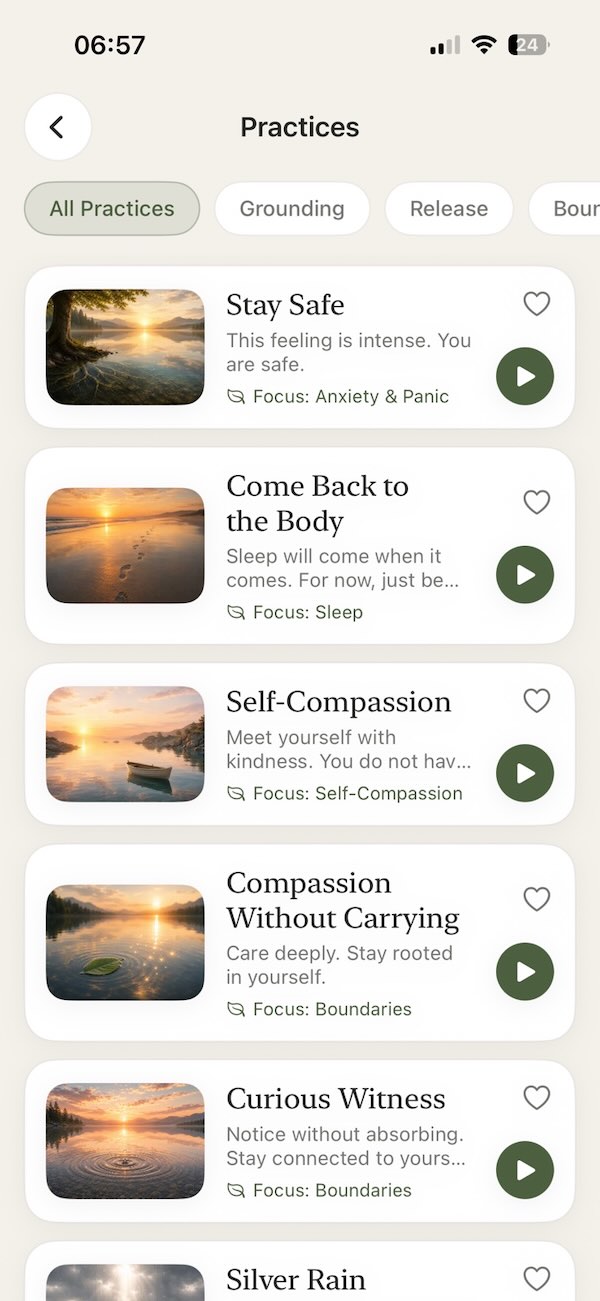
Boundary guilt rarely yields to logic, but it softens in the presence of kindness. Self-Compassion is a gentle practice for the guilty moments after a boundary — a way to meet the feeling with warmth instead of obeying it, remind yourself that limits don't make you bad, and stay on your own side while the guilt passes.

Try the practice
Self-Compassion
Offer yourself the kindness you need.
Ready for more support?
Continue your journey in Aira
Access the full library of guided practices, tools, and resources anytime, anywhere.
- 10+Guided Practices
- AnxietyRelief Tools
- SleepSupport
- TrackYour Progress
- OfflineAccess
Available on iPhone and iPad