Saying No Without Guilt: How to Decline and Mean It
Why saying no feels so hard, why it isn't unkind, simple ways and scripts to decline, and how to handle the guilt that comes after.

For some people, no is one of the hardest words in the language. You feel it clearly — you don't want to, you don't have time, it isn't right for you — and somehow yes comes out anyway. And when you do manage a no, the guilt can be so sharp that it hardly feels worth it. If saying no leaves you anxious, apologetic, or quietly resentful, you're not alone, and it's a skill you can build.
This is a guide to saying no without guilt: why it's so hard, why it isn't the unkind act you fear, and how to actually do it — words included.
Why is saying no so hard?
Saying no can feel almost dangerous, and usually that's learned. If, growing up, your no led to conflict, disappointment, or withdrawn warmth — or if your value came from being helpful and easy — then your nervous system learned that no risks the relationship. So you say yes to stay safe, even at your own expense. The difficulty isn't a character flaw; it's an old strategy that once kept you connected. (The deeper pattern of the compulsive yes — the need for approval underneath it — has its own guide on people-pleasing.)
Saying no isn't unkind
The belief that stops most people is that no is selfish or hurtful. It isn't. A no to someone else is a yes to something of yours — your time, your energy, your wellbeing, your other commitments. Declining a request doesn't make you a bad person; it makes you a finite one, which everyone is. And an honest no is kinder than a yes you'll resent, because resentment quietly poisons a relationship in a way a clear, warm no never does.
Why you feel guilty when you say no
If guilt floods in the moment you decline, it helps to know what that guilt usually is. It's rarely evidence that you did something wrong — it's the discomfort of doing something unfamiliar. If you were taught that your job is to accommodate, then the healthy act of declining will feel wrong long before it feels freeing. The guilt is a withdrawal symptom of people-pleasing, not a moral signal, and it fades as no becomes more familiar.
How to say no — simple ways that work
You don't need to be harsh, and you don't need a perfect excuse.
Keep it short
The longer the explanation, the more room for negotiation. A brief no is clearer and easier to hold.
You don't owe a detailed reason
I can't is enough. Over-explaining turns your no into a case you have to win.
Don't offer an excuse you'll have to defend
A made-up reason can be argued with. That doesn't work for me can't.
Buy time if you need it
Let me check and get back to you breaks the reflex to say yes on the spot and gives you room to decide.
Be warm and firm together
Kindness and clarity aren't opposites. You can decline gently and still mean it.
What to actually say
Some phrases to borrow when your mind blanks: Thanks for asking, but I can't. / That doesn't work for me right now. / I'm going to pass on this one. / I'd love to, but I can't take anything else on. / No, but I hope it goes well. Notice none of them apologise excessively or over-explain. A clean no needs neither, whether you're saying no politely to a colleague or kindly to a friend.
Saying no at work and to family
Two of the hardest arenas. At work, a no often lands best paired with priorities: I can take this on if we move the other deadline — which would you prefer? With family, where guilt runs deepest, shorter and steadier usually beats a long justification that invites debate. In both cases, you're allowed to decline without a flawless reason.
When the guilt comes anyway
Sometimes you'll say no well and still feel awful. That's okay — the goal isn't to feel no guilt, it's to stop letting guilt make your decisions. You can let the guilt be present, remind yourself it's a sign of unfamiliarity rather than wrongdoing, and not rush to undo your no just to make the feeling stop. The guilt passes; the boundary, and the self-respect, remain.
The fuller picture
What makes no stick in your throat is one belief: saying no is selfish or unkind — and the guilt I feel right after proves I did something wrong. It feels true because the discomfort is immediate and physical, and because you may have learned early that your no risked conflict or lost warmth.
But examine both halves. A no to someone else is simply a yes to something of yours — your time, energy, wellbeing, the commitments you already hold. Declining doesn't make you a bad person; it makes you a finite one, which everyone is. And an honest no is often kinder than a yes you'll resent, because resentment quietly corrodes a relationship in a way a warm, clear no never does. As for the guilt — it isn't a verdict. It's a withdrawal symptom: if you were trained to accommodate, the healthy act of declining will feel wrong long before it feels freeing, and that wrongness is unfamiliarity, not wrongdoing. So the guilt arriving doesn't mean you owe an apology or should take the no back. It means you did something new. You can let it be there, and let the boundary stand.
Final thoughts
Learning to say no is really learning that your needs count too — that you're allowed to take up space, have limits, and disappoint someone occasionally without it meaning you're bad. You won't do it perfectly, and the guilt won't vanish overnight. But every honest no makes the next one easier, and slowly rebuilds a self that doesn't disappear every time someone asks for something. One clear, kind no at a time.
Try a gentle practice
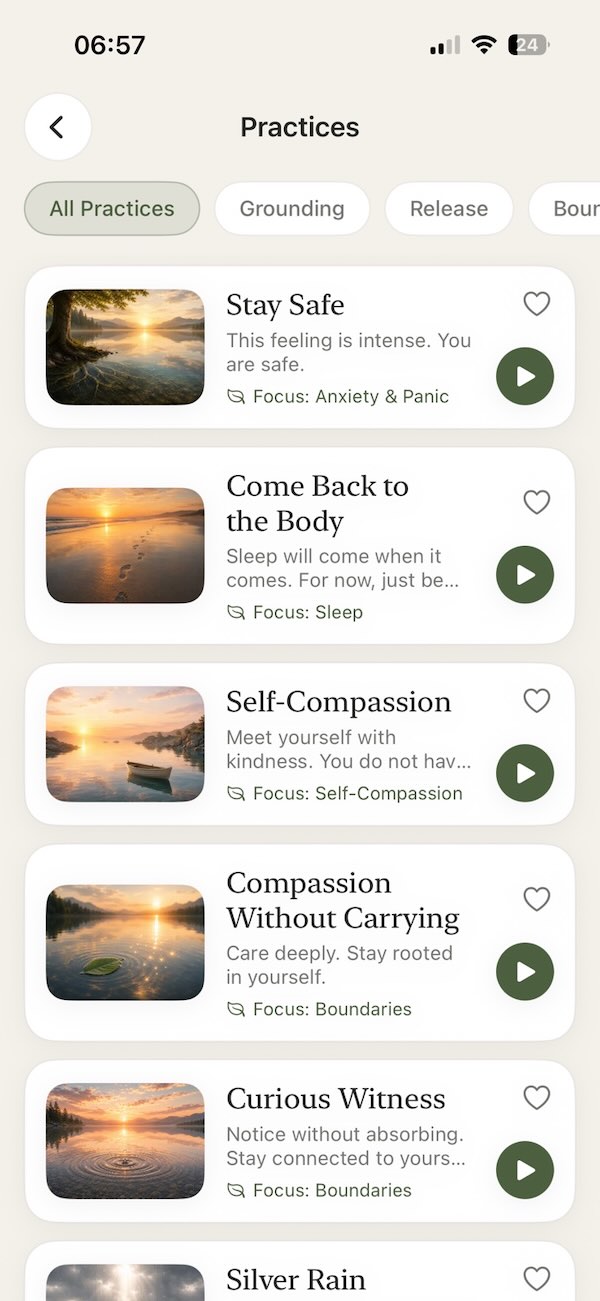
The guilt after a no can be loud, and it tempts you to take it all back. Self-Compassion is a gentle practice for those moments — a way to meet the guilt with warmth instead of obeying it, remind yourself that having limits doesn't make you unkind, and stay on your own side after you've said no.

Try the practice
Self-Compassion
Offer yourself the kindness you need.
Ready for more support?
Continue your journey in Aira
Access the full library of guided practices, tools, and resources anytime, anywhere.
- 10+Guided Practices
- AnxietyRelief Tools
- SleepSupport
- TrackYour Progress
- OfflineAccess
Available on iPhone and iPad