Guilt and Self-Blame: When You Carry More Than Is Yours to Carry
Why guilt and self-blame become chronic, the difference between healthy and irrational guilt, guilt after setting boundaries, and how to stop feeling guilty all the time.

Some people feel guilt only when they've genuinely done something wrong. Others feel it almost constantly — for saying no, for resting, for other people's moods, for things that were never theirs to control. If you apologise reflexively, replay your part in everything that goes wrong, and carry a low hum of it's my fault through the day, you know how heavy chronic guilt can be.
This is a guide to guilt and self-blame: where they come from, the difference between guilt that helps and guilt that only hurts, and how to stop carrying more than is actually yours. (Guilt's close cousin is shame — guilt says I did something bad, shame says I am bad — and the two often travel together; shame has its own guide.)
Healthy guilt vs the kind that just hurts
Guilt isn't the enemy. In its healthy form it's a useful signal: you acted against a value you hold, and the discomfort points you toward repair. That guilt is specific, proportionate, and time-limited — it arrives, prompts an apology or a change, and then it's done. The trouble is the other kind: guilt that's vague, oversized, and permanent, that shows up when you've done nothing wrong, and that no amount of apologising ever resolves. The first kind is information. The second is just suffering.
Irrational guilt
Irrational guilt is guilt without a genuine wrong behind it — feeling responsible for things outside your control, for other people's feelings, for simply having needs. It often sounds like I should have done more, it's somehow my fault, I've let everyone down, even when a fair look at the facts says otherwise. The feeling is real, but the verdict isn't accurate. Irrational guilt confuses I feel guilty with I am guilty, and those are not the same thing — emotions aren't evidence.
Guilt and self-blame
Self-blame is guilt turned into a habit of explanation: whatever goes wrong, you reach for your own fault first. It can feel almost responsible, even mature — but blanket self-blame isn't accuracy, it's a pattern. Often it's strangely protective: if it's your fault, then at least it's within your control, and control feels safer than the helplessness of some things just happen. So self-blame trades an honest, uncomfortable uncertainty for a familiar, painful certainty — and calls it taking responsibility.
Why guilt becomes chronic
Chronic guilt — feeling guilty all the time — usually isn't about any single event. It's more like a setting, often learned early, in environments where you were made responsible for others' emotions, where love came with obligation, or where you absorbed the sense that your needs were a burden. Over time the nervous system learns to scan for ways you might be at fault, and it finds them, because an anxious, guilt-prone mind can always construct a case. Guilt and self-blame also feed overthinking, looping the same should I have questions long after a mistake, without ever reaching resolution.
Guilt anxiety and self-blame anxiety
Guilt and anxiety amplify each other. The anxious mind asks what if I did something wrong? what if they're upset with me? what if it's my fault? — and guilt answers yes, probably. This guilt anxiety keeps you over-apologising, over-explaining, and over-functioning to pre-empt blame, which is exhausting and quietly reinforces the belief that you're always one step away from being at fault. Self-blame anxiety is the same loop pointed inward: the more anxious you feel, the more you assume the cause must be something you did.
Guilt after setting boundaries
One of the most common and most confusing forms is the guilt that follows saying no. You set a reasonable boundary — declining a request, protecting your time, putting a need first — and instead of relief you feel as though you've done something wrong. But guilt after a boundary is usually not a sign you were selfish; it's a sign the boundary is unfamiliar. If you were taught that your role is to accommodate, then doing the healthy thing will feel wrong long before it feels freeing. The guilt is a withdrawal symptom, not a moral verdict.
How to stop feeling guilty
The aim isn't to never feel guilt — it's to stop obeying the guilt that isn't telling the truth.
Check the charge
Ask: did I actually do something against my values, or do I just feel like I did? If there's a real wrong, repair it. If there isn't, the guilt is a feeling to sit with, not an instruction to act on.
Right-size your responsibility
Most situations are shared. Try naming the part that was genuinely yours — and, just as deliberately, the parts that belonged to others, to circumstance, or to chance.
Let the feeling exist without paying it off
Guilt makes you want to apologise, over-give, or self-punish to make it stop. Allowing the feeling to be present, without acting on it, teaches your nervous system that guilt isn't always a command.
Bring in self-compassion
Guilt and self-blame respond far better to honesty delivered with warmth than to punishment. You can hold yourself accountable and stay on your own side at the same time.
The fuller picture
At the centre of chronic guilt is one silent leap: if I feel guilty, I must be guilty — it's my fault. It feels true because the feeling is so physical and so insistent; surely something this heavy must be pointing at a real wrong.
But a feeling is not evidence. Guilt confuses I feel guilty with I am guilty, and those are entirely different claims — one is a sensation, the other is a fact that has to be checked against what actually happened. So check it: did I act against a value I hold, or do I just feel as if I did? Real guilt is specific, proportionate, and it points to a repair. The other kind is vague, oversized, and permanent, and no apology ever resolves it — because there was no genuine wrong to resolve. Notice, too, that self-blame is quietly protective: if it's your fault, at least it's in your control, and control feels safer than some things just happen. And the guilt that follows a boundary isn't proof you were selfish — it's a withdrawal symptom from a habit of accommodating, and it fades. You're allowed to be one person among many in a situation, and to set down the share that was never yours to carry.
Final thoughts
If you carry guilt and self-blame everywhere, it doesn't mean you're a bad person — ironically, it usually means the opposite, because people who genuinely don't care rarely feel much guilt at all. The work isn't to stop caring; it's to stop confusing every uncomfortable feeling with proof of wrongdoing. You're allowed to have needs, to set boundaries, to be one person among many in a situation, and to put down the share that was never yours. One honest look, one breath, one kinder verdict at a time.
Try a gentle practice
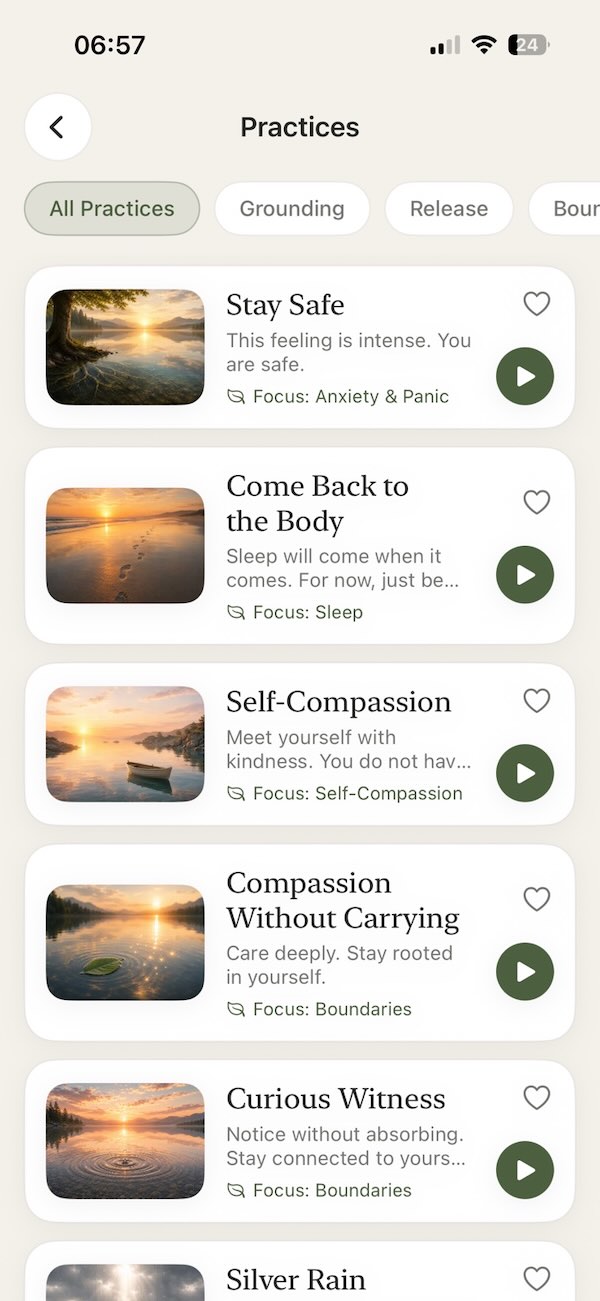
When guilt and self-blame are loud, the mind keeps reaching for ways you're at fault. Self-Compassion is a gentle practice for those moments — a way to soften the self-attack, hold your actual responsibility honestly and gently, and stop carrying the weight that was never yours to begin with.

Try the practice
Self-Compassion
Offer yourself the kindness you need.
Ready for more support?
Continue your journey in Aira
Access the full library of guided practices, tools, and resources anytime, anywhere.
- 10+Guided Practices
- AnxietyRelief Tools
- SleepSupport
- TrackYour Progress
- OfflineAccess
Available on iPhone and iPad