When Anxiety Focuses on Your Health
A headache, a flutter, a strange sensation — and suddenly hours of worried searching. A compassionate look at health anxiety, the reassurance cycle, and how to step out of it.

Have you ever noticed a sensation in your body, searched for it online, and ended up convinced that something was seriously wrong? Maybe it started with a headache, a flutter in your chest, dizziness, fatigue, or a strange feeling you couldn't explain, and what began as a small concern quickly turned into hours of research, worry, and checking. If this sounds familiar, you may be experiencing health anxiety. It can be exhausting, leaving you trapped between wanting reassurance and never fully feeling reassured. The good news is that you're not alone, and these experiences are far more common than many people realize.
What Is Health Anxiety?
Health anxiety is a pattern of persistent worry about your health, your symptoms, or the possibility of illness. People with health anxiety often become highly focused on bodily sensations and may interpret normal or harmless experiences as signs of a serious medical condition. This doesn't mean the symptoms feel imaginary — the sensations are real, and the fear is real. What anxiety changes is the meaning your mind assigns to those sensations.
Common Health Anxiety Symptoms
Health anxiety symptoms can include frequently worrying about illness, constantly monitoring your body, repeatedly checking symptoms online, seeking reassurance from friends, family, or doctors, difficulty trusting medical results, a fear that something has been missed, scanning for signs of disease, and feeling unable to stop thinking about health concerns. Many people with illness anxiety become caught in a cycle where temporary reassurance helps for a short time, but the fear soon returns.
Why Anxiety Makes Body Sensations Feel More Intense
One of the most confusing parts of anxiety is that it can create real physical symptoms. Anxiety activates the body's stress response, which can cause a rapid heartbeat, chest tightness, dizziness, tingling sensations, stomach discomfort, muscle tension, shortness of breath, and fatigue. When these sensations appear unexpectedly, it's natural to wonder whether something is wrong — and the challenge is that anxiety often reacts to the sensations by creating even more fear, which then produces even more symptoms. The cycle can feed itself.
Anxiety and Overthinking About Health
Health anxiety and overthinking often go hand in hand. A single sensation can trigger a chain of thoughts — what if this is serious? what if doctors missed something? what if it gets worse? what if I'm ignoring an important warning sign? The mind begins searching for certainty. Unfortunately, certainty is rarely available when it comes to health, and the more we demand it, the more anxiety tends to grow.
The Problem With Checking Symptoms Online
When anxiety about symptoms appears, searching online can feel like the responsible thing to do, and sometimes it does provide useful information. But for many people with health anxiety, symptom checking becomes part of the anxiety cycle. Search results often focus on worst-case scenarios, and a single common symptom may be linked to dozens of possible conditions, including rare illnesses. An anxious brain naturally pays attention to the most threatening explanation, so instead of feeling calmer, you may end up more frightened than before.
Anxiety and Medical Tests
Many people with health anxiety feel temporary relief after medical appointments or tests, but the reassurance often doesn't last. New doubts appear — what if the test was wrong? what if they checked the wrong thing? what if something develops later? This is why reassurance alone rarely solves health anxiety. The problem isn't a lack of information; it's that anxiety keeps demanding more certainty than life can provide.
Fear of Serious Illness
Fear of illness is deeply human, and most people worry about their health at times. Health anxiety becomes more disruptive when that fear begins controlling daily life, relationships, sleep, work, or decision-making. You may find yourself avoiding activities, constantly checking your body, repeatedly seeking reassurance, struggling to focus on anything else, and feeling trapped by worry. When this happens, anxiety itself often becomes a larger burden than the symptoms that first triggered the concern.
Breaking the Reassurance Cycle
Many people are surprised to learn that reassurance can sometimes strengthen health anxiety. Each time anxiety appears and reassurance temporarily reduces it, the brain learns I need reassurance to feel safe — and over time that need can grow stronger. Recovery often involves learning to tolerate uncertainty rather than eliminating it completely. This can feel uncomfortable at first, but it helps build long-term confidence.
Health Anxiety Recovery
Recovery doesn't mean never worrying about your health again. It means changing your relationship with uncertainty, body sensations, and fear. Many people find improvement through grounding exercises, mindfulness practices, limiting symptom-checking behaviors, reducing reassurance seeking, learning about anxiety responses, professional support when needed, and self-compassion during difficult moments. Most importantly, recovery involves recognizing that a sensation isn't automatically a danger signal — your body experiences thousands of sensations every day, and not all of them require action.
The fuller picture
At the centre of health anxiety is a thought that feels urgent and completely reasonable: this sensation must mean something is seriously wrong — and I can't relax until I'm totally sure I'm okay. Of course it feels that way: the sensation is real, and the mind treats not-knowing as danger.
But here's what the fear skips over. A sensation is information, not a verdict — your body produces thousands of them a day, and the overwhelming majority mean nothing at all. And the demand for complete certainty is the trap itself: health is never 100% certain for anyone, so chasing that feeling keeps you searching with no finish line. Each check buys a few minutes of calm, then resets the fear a little stronger. A genuine concern deserves a doctor, not a 2am search bar — but most sensations simply need to be allowed to be sensations. "Probably fine" is a place you're allowed to rest.
Final Thoughts
When anxiety focuses on your health, it can feel convincing, urgent, and impossible to ignore. But having anxiety about illness doesn't automatically mean you're seriously ill. Often, anxiety turns normal uncertainty into a constant search for answers that never feels complete. If you find yourself trapped in cycles of checking, researching, or monitoring your body, remember this: you don't have to solve every sensation, you don't have to achieve perfect certainty, and you don't have to face these worries alone. With time, support, and practice, it's possible to step out of the cycle and reconnect with a greater sense of calm and trust.
Frequently asked questions
Is health anxiety the same as hypochondria?
Pretty much — "health anxiety" is simply the kinder, more accurate name for what used to be called hypochondria (clinically, illness anxiety disorder). It doesn't mean you're making things up or being dramatic. It's a real, recognised anxiety pattern, and it responds well to support.
How do I stop checking my symptoms online?
Gently, rather than cold turkey. The key thing to notice is that searching is part of the cycle, not a way out of it — it soothes you for a few minutes, then hands you a scarier result and resets the fear. It helps to delay the search, shrink the window a little each time, and treat the urge to check as anxiety asking for reassurance rather than a genuine emergency.
How can I tell if it's health anxiety or a real medical problem?
Honestly, from the inside you often can't — and that uncertainty is the hard part. A useful rule of thumb: a real concern deserves one proper check with a doctor, not endless re-checking and re-searching. If something is new, severe, or persistent, get it looked at. But once a doctor has actually reassured you, more reassurance-seeking tends to feed the anxiety rather than settle it.
Does health anxiety ever go away?
It can ease a great deal. Recovery usually isn't about finally reaching total certainty about your health — that doesn't exist for anyone — but about changing your relationship with uncertainty and body sensations, so that a stray symptom stops hijacking your whole day.
Try a gentle practice
Health anxiety asks us to watch our bodies very closely — to analyse, to check, to search for certainty. Observe is a gentle practice for moments when anxiety is focused on your body and every sensation feels important: a way to shift from analysing to observing, to step back, slow down, and notice what's here without needing to decide what it means.

Try the practice
Observe
Let's step back and see more clearly
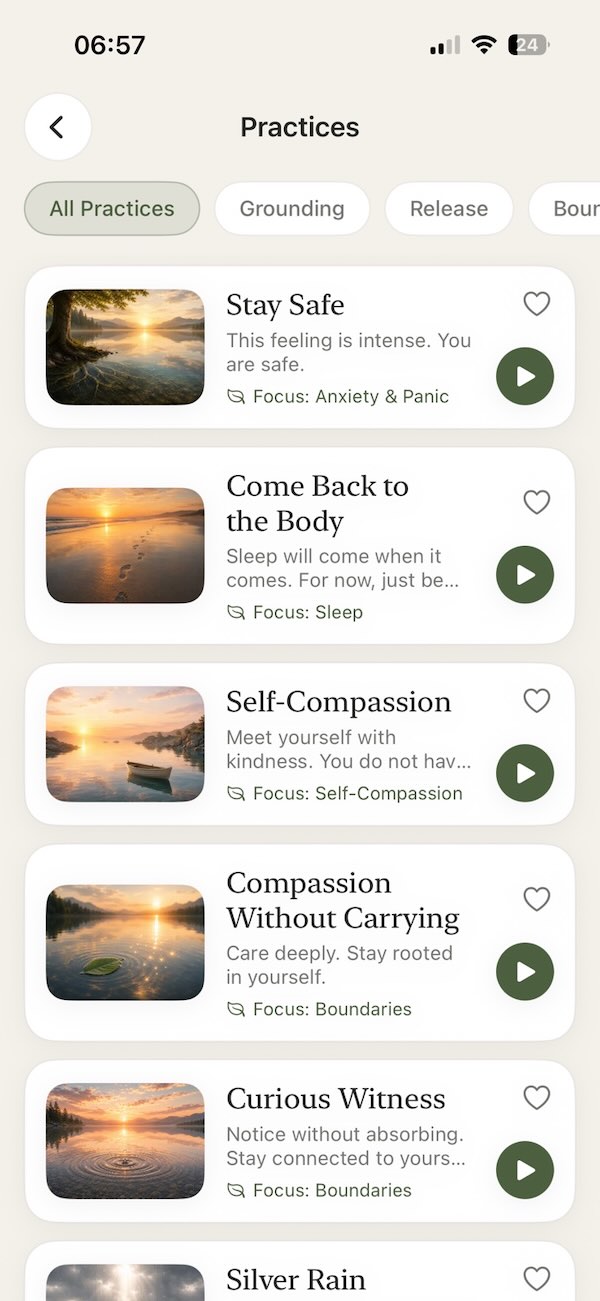
Ready for more support?
Continue your journey in Aira
Access the full library of guided practices, tools, and resources anytime, anywhere.
- 10+Guided Practices
- AnxietyRelief Tools
- SleepSupport
- TrackYour Progress
- OfflineAccess
Available on iPhone and iPad