High-Functioning Burnout: When You're Burning Out but Still Coping
What high-functioning burnout is, why it stays hidden when you're still performing, the signs underneath, and why you don't have to collapse to deserve rest.

From the outside, you look fine — maybe better than fine. You're hitting deadlines, showing up, holding it together, perhaps even high-achieving. But inside, you're running on empty: exhausted, joyless, held up by willpower and caffeine. This is high-functioning burnout, and it's especially easy to miss, because the one sign everyone looks for — falling apart — is exactly the one you're working hardest to hide.
This is a guide to high-functioning burnout: what it is, why it stays hidden, and why you don't have to collapse before you're allowed to rest.
What is high-functioning burnout?
High-functioning burnout is burnout in someone who is still performing. You meet the depletion, exhaustion, and detachment of burnout — but you keep functioning, often at a high level, through sheer drive and self-discipline. Because your output looks fine, no one around you (sometimes including you) registers that anything is wrong. The competence masks the cost.
Why it's so easy to miss
We picture burnout as a dramatic collapse — the person who can't get out of bed. High-functioning burnout doesn't look like that, so it slips under the radar. You're still delivering, still reliable, still the one people count on. The gap between how you appear and how you feel becomes its own burden: you're praised for coping while quietly falling apart, which can make you doubt whether you have any right to feel as bad as you do. You do.
The signs underneath the competence
Behind the functioning, the familiar burnout signs are there: exhaustion that sleep doesn't fix, going through the motions without feeling, irritability or numbness, dread, and a joylessness in things you used to enjoy. You might run on adrenaline and deadlines to keep moving, crash hard the moment you stop (getting ill on the first day of a holiday is classic), and carry a quiet sense that you can't keep this up — even as you keep it up. The body and mind are sending signals; the functioning just drowns them out.
Why high-functioning people burn out
The same traits that make you high-functioning often drive the burnout: conscientiousness, perfectionism, a strong work ethic, difficulty saying no, and a sense that your worth is tied to productivity. These keep you delivering long past the point where you should have stopped — because stopping feels like failing, and slowing down feels unsafe. (Perfectionism and people-pleasing both feed this, and each has its own guide.)
Why you don't have to collapse to deserve rest
The cruelest feature of high-functioning burnout is the belief that until you actually break down, you haven't earned the right to rest. So you wait for a collapse to give you permission — which often means you don't stop until your body forces it. But you don't have to fall apart to deserve care. The signals you already have — the exhaustion, the joylessness, the dread — are reason enough. Catching burnout while you're still functioning is far better than waiting until you can't.
The fuller picture
The engine of high-functioning burnout is one rule: I'm still coping, so it can't be that bad — until I actually fall apart, I haven't earned the right to stop. It feels true because the evidence seems to back it: deadlines met, people relying on you, output intact. If you can still do it all, surely you're fine.
But that rule sets collapse as the only proof it will accept — which means you're required to break down before you're allowed to rest, so you don't stop until your body forces the issue with illness or a crash. Notice the trap: the more capable you are, the longer you can override the warning signs, so competence doesn't prove you're okay — it just prolongs how long you can run on empty without it showing. The exhaustion, the joylessness, the dread, the crash the moment you pause — those are the signals, and functioning drowns them out rather than cancelling them. You don't need a breakdown to validate what you already feel. Waiting for one isn't strength; it's the belief costing you the recovery you could have now. Your exhaustion counts while you're still standing — that's exactly the point to honour it, before it has to knock you down to be heard.
Final thoughts
High-functioning burnout is real burnout, even though you're still holding it together — maybe especially because you're still holding it together at such a cost. You don't have to wait until you collapse, or prove how bad it is, before you're allowed to slow down and take care of yourself. The fact that you can keep going doesn't mean you should keep going like this. Your exhaustion counts now, while you're still standing. One honoured signal, one permitted rest at a time.
Try a gentle practice
High-functioning burnout runs on the belief that you can't stop until everything's done or until you break. Permission to Rest is a gentle practice for exactly that — a way to let yourself pause now, without earning it through collapse, and to remind the driven part of you that you're allowed to rest even while you're still coping.

Try the practice
Permission to Rest
You've done enough. You're allowed to rest.
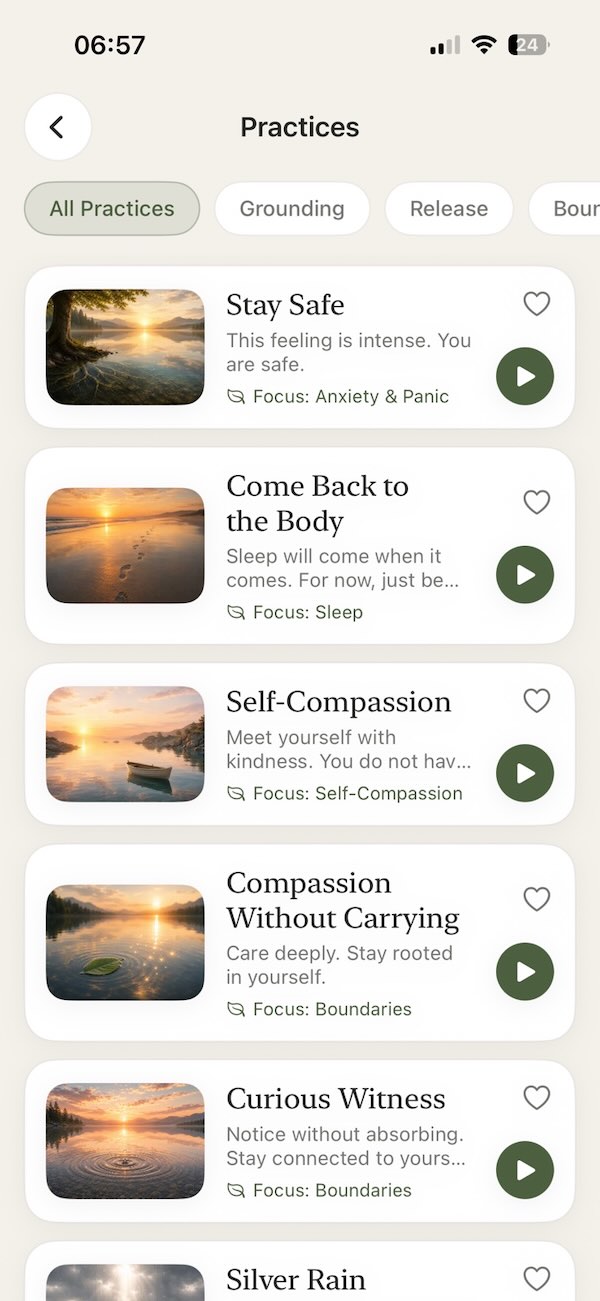
Ready for more support?
Continue your journey in Aira
Access the full library of guided practices, tools, and resources anytime, anywhere.
- 10+Guided Practices
- AnxietyRelief Tools
- SleepSupport
- TrackYour Progress
- OfflineAccess
Available on iPhone and iPad