The Highly Sensitive Person: Boundaries for a Sensitive Nervous System
What a highly sensitive person is, the signs and traits of HSPs, why overstimulation and absorbing others' emotions happen, and how boundaries protect you.

Some people feel everything more. Bright lights, loud rooms, other people's moods, subtle details, criticism, beauty — it all lands harder and lingers longer. If you've often been told you're 'too sensitive,' get overwhelmed in busy environments, or soak up the emotions of everyone around you, you may be what researchers call a highly sensitive person. It isn't a flaw or a disorder — it's a trait, and one that comes with real gifts and real costs.
This is a guide to being a highly sensitive person: what it is, the signs, why it can be so overwhelming, and how boundaries help you protect a finely tuned nervous system without shutting the world out.
What is a highly sensitive person?
A highly sensitive person (HSP) has a nervous system that processes everything more deeply — sensory input, emotions, social cues, subtle details. The trait, studied under the name sensory processing sensitivity, is thought to affect a substantial minority of people, and it's completely normal. HSPs tend to notice more, feel more intensely, and reflect more deeply, which is why they're often empathetic, perceptive, and creative. The flip side is that the same depth of processing leads to overstimulation and emotional overwhelm more easily than it does for others.
Signs and traits of a highly sensitive person
You might recognise yourself in some of these:
- You're easily overwhelmed by bright lights, loud noise, busy places, or chaos.
- You feel others' emotions strongly, sometimes as if they were your own.
- You need time alone to recover after socialising or stimulation.
- You're deeply moved by art, music, or beauty.
- You notice subtleties and details others miss.
- You're affected strongly by criticism or conflict.
- You have a rich, complex inner life and process things deeply.
Having a few of these doesn't necessarily make you an HSP, but if most resonate, high sensitivity may be part of how you're wired. Am I a highly sensitive person? is usually answered by how deeply and how easily you're affected.
Why being highly sensitive can feel overwhelming
For an HSP, the world simply delivers more input — and a sensitive nervous system processes all of it. In a loud, fast, crowded modern environment, that can tip into overstimulation: a frazzled, overloaded, 'too much' feeling that others around you don't seem to share. Add in absorbing other people's emotions, and a sensitive person reaches overwhelm quickly, then needs real recovery time. This isn't weakness or fragility — it's a nervous system doing a great deal of processing, which is tiring in a world that rarely slows down.
High sensitivity and boundaries
This is why boundaries matter so much for HSPs. If you feel everything intensely and absorb everyone's emotions, then without boundaries you'll be flooded constantly — overstimulated, drained, and unsure which feelings are even yours. For a highly sensitive person, boundaries aren't optional self-indulgence; they're basic maintenance. Protecting your time, your sensory environment, your recovery, and your emotional space is how you keep your sensitivity a gift rather than a source of chronic overwhelm.
How to protect yourself as a highly sensitive person
You don't need to become less sensitive — you need to honour the nervous system you have.
Protect your sensory environment
Reduce overstimulation where you can: quieter spaces, lower lights, fewer back-to-back commitments. Managing your input is a legitimate boundary.
Build in recovery time
HSPs need downtime to process. Protecting solitude after stimulation isn't antisocial — it's how you reset.
Notice whose emotions you're carrying
When you feel flooded, pause and ask: is this mine? Much of an HSP's overwhelm is absorbed from others, and naming that begins to give it back.
Honour your limits without apology
You're allowed to leave early, decline the loud event, or need quiet, without justifying it. Your threshold is simply different, and that's okay.
The fuller picture
Under years of being called 'too sensitive' sits one belief: my sensitivity is a flaw — a weakness, something wrong with me that I should override or toughen out of. It feels true because you overwhelm more easily than the people around you, and a world that rarely slows down keeps treating that as a defect.
But sensitivity isn't a malfunction — it's a trait. A highly sensitive nervous system simply processes more: more sensory input, more emotion, more subtle detail, all of it more deeply. The overwhelm you feel isn't fragility; it's a system doing a great deal of processing in an environment built for a different threshold. And the very same depth is where your empathy, perception, and creativity come from — you can't keep those and delete the sensitivity, because they're the same wiring. So too much was never a verdict on you; it was a mismatch between your threshold and someone else's, mistaken for a flaw. The task was never to become less sensitive or override the way you're built. It's to honour it — protected quiet, real recovery, emotional space that's yours — so the sensitivity gets to be the gift it is instead of a source of constant overwhelm.
Final thoughts
Being a highly sensitive person isn't something to fix — it's a way of being wired that brings depth, empathy, and perception, alongside a real need for care. The world won't slow down for your nervous system, so the kindest thing you can do is build the boundaries that let you thrive in it: protected quiet, real recovery, and emotional space that's your own. Your sensitivity isn't too much. It just needs honouring rather than overriding. One protected quiet hour, one is this mine?, one honoured limit at a time.
Try a gentle practice
When a sensitive nervous system tips into overstimulation, coming back to the body and the present moment helps it settle. Ground is a gentle practice for exactly that — a way to steady yourself when everything feels like too much, return from overwhelm to the solid present, and find the calm a highly sensitive person needs to reset.
Try the practice
Ground
Let's come back to what's real
Ready for more support?
Continue your journey in Aira
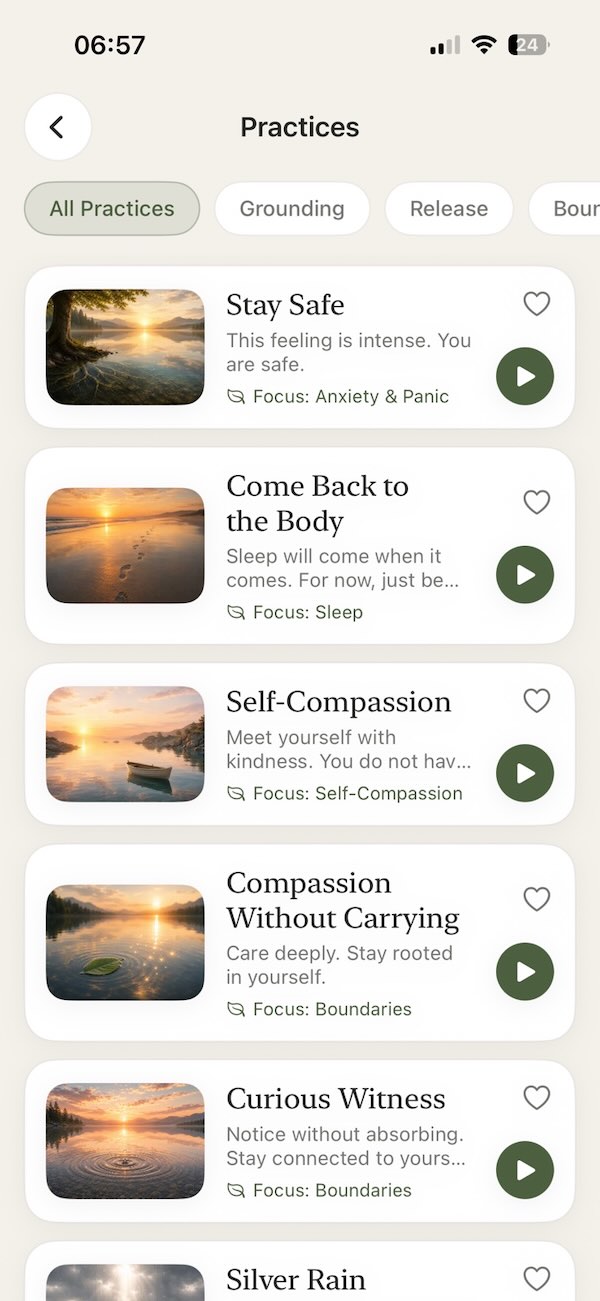
Access the full library of guided practices, tools, and resources anytime, anywhere.
- 10+Guided Practices
- AnxietyRelief Tools
- SleepSupport
- TrackYour Progress
- OfflineAccess
Available on iPhone and iPad