How Long Does Grief Last? (There's No Timeline)
"How long is this going to last?" There's no fixed answer — and that's gentler than it sounds. Here's the truth about grief's timeline, and why there's no deadline to hit.

Sooner or later, almost everyone who grieves asks it: how long is this going to last? When will the weight lift? When will I feel like myself again? It's a completely human question — you're tired, and you want to know there's an end in sight.
Here's the honest answer, and it's gentler than it first sounds: grief has no fixed timeline. There's no set number of weeks or months after which you're supposed to be finished. And while that can feel daunting, it also frees you from a deadline you were never going to meet anyway.
Why we expect grief to have a deadline
We live in a culture that quietly treats grief like a wound that should heal on schedule. Bereavement leave lasts a few days. People expect you to be "back to normal" within a few weeks. There's an old idea that a year — once you've passed every birthday, holiday, and anniversary once — should more or less do it.
So when you're still aching at six months, or a year, or three years, it's easy to conclude you're doing it wrong. You're not. These timelines were never based on how grief actually works. They're based on how quickly other people get comfortable again.
Grief doesn't end — it changes shape
Here's a more accurate picture. For most people, the sharpest, most consuming pain does soften over time. But grief rarely disappears completely. Instead, it changes shape: from something that fills every moment to something you carry, that surfaces now and then, often in waves.
This is why people who lost someone decades ago can still tear up at a song. That's not unhealed grief. That's love that outlasts the sharpest pain. Healing isn't the absence of grief — it's grief taking up a livable amount of space, so the rest of your life can grow around it.
Why a hard day later isn't "going backwards"
Because grief eases unevenly, you'll have stretches where you feel almost okay — and then a brutal day out of nowhere. It's tempting to read that bad day as proof you've regressed. You haven't.
Progress in grief isn't a straight line down. It's good days and bad days, with the good ones slowly outnumbering the bad over a long time. A rough afternoon months in doesn't erase the healing underneath. If this loop-back feeling is familiar, the stages of grief article explains why grief was never linear to begin with.
"Am I taking too long?"
Probably not. How long grief lasts depends on countless things: who you lost, how close you were, how the loss happened, what support you have, and everything else life is asking of you at the same time. Comparing your timeline to someone else's — or to an imagined "normal" — only adds pressure to an already heavy load. If you keep checking yourself against a standard, it may help to read why there's no single right way to grieve in is my grief normal.
A gentler way to hold the question
Here's a small shift that helps. Instead of how long until grief ends?, try how do I live well alongside this for now? The first question keeps you waiting for a finish line that doesn't exist. The second lets you actually live — to find moments of rest, connection, and even joy without feeling like you're rushing grief or betraying the person you lost.
You don't have to hurry. You don't have to be "over it" by any date. Grief gets to take the time it takes, and you get to be gentle with yourself the whole way through.
When to reach for more support
There's no deadline for grief — but there is a point where extra support helps. If, after a long time, the pain hasn't softened at all, if you can't begin to re-engage with daily life, or if you feel permanently stuck or unable to find any meaning or purpose, that can be a sign of what's sometimes called complicated or prolonged grief, and a doctor or grief counselor can genuinely help. Reaching out isn't admitting you're too slow. It's getting company for a road that's longer than anyone warned you.
Try a gentle practice
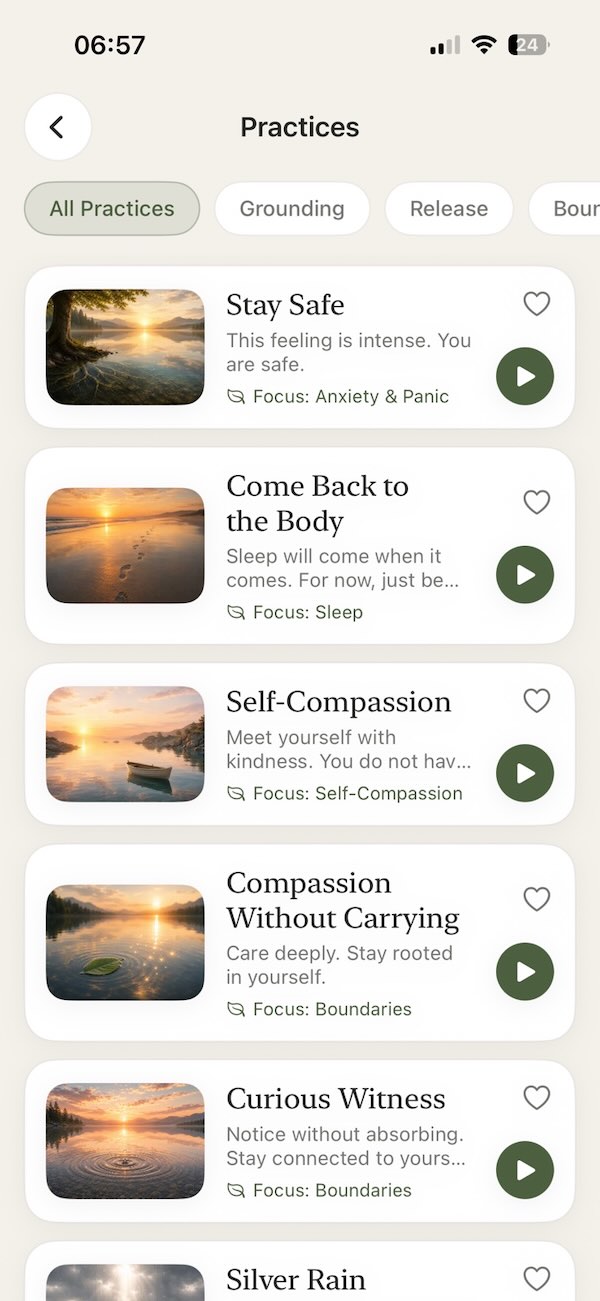
When you stop chasing a finish line, there's often nothing you need to do but be here. Nothing Left to Do is a gentle practice for the moments grief feels endless — a way to set down the pressure to heal on schedule, release the need to fix anything, and simply rest where you are.

Try the practice
Nothing Left to Do
Release the day. Prepare for deep restorative sleep.
Ready for more support?
Continue your journey in Aira
Access the full library of guided practices, tools, and resources anytime, anywhere.
- 10+Guided Practices
- AnxietyRelief Tools
- SleepSupport
- TrackYour Progress
- OfflineAccess
Available on iPhone and iPad