Finding Meaning After Loss: Learning to Live With It
Not moving on, not forgetting — but learning to carry it. Here's what finding meaning after loss actually looks like, and how life slowly grows around grief.

There comes a point in grief — not at the start, but later — when the rawest pain has softened just enough for a quieter, harder question to surface: how do I live now? Not how do I get over this, but how do I carry it and still have a life. If you've reached that question, you're not betraying anyone. You're beginning one of the most tender parts of grief: learning to live alongside loss.
"Moving on" is the wrong goal
Let's clear away a phrase that hurts more than it helps: moving on. It suggests leaving the person or the loss behind, closing the door, getting back to who you were. But you don't move on from someone who mattered. You don't return to your old self, because loss changes you.
The goal was never to move on. It's to move forward — carrying them with you, not leaving them behind. That single reframe takes an enormous, impossible pressure off your shoulders.
What finding meaning actually means
Grief researchers talk about continuing bonds — the idea that healthy grieving doesn't sever your connection to who or what you lost, but transforms it. The relationship doesn't end; it changes form. You carry their values, their humor, their love into how you live. Finding meaning isn't about deciding the loss was "worth it" or had a tidy purpose. It's about discovering that your life can still hold meaning with the loss woven into it.
This is slow, and it can't be forced. Meaning isn't something you manufacture on a schedule — it tends to arrive sideways, in small moments, when you're not demanding it.
Your life grows around the grief
Here is one of the truest images of long-term grief. We imagine that healing means the grief shrinks until it's small enough to manage. But often the grief stays the same size — and your life grows around it. You build new experiences, relationships, and meaning, and gradually the grief, while still there, takes up a smaller proportion of a larger life.
This is why you can be genuinely happy again and still ache on certain days. The grief didn't shrink. Your life got bigger around it. Both are true at once, and that's not a contradiction — it's healing.
Letting joy back in without guilt
One of the hardest parts of living again is the guilt that comes with joy — the sense that laughing, loving, or being happy somehow betrays the person you lost. It doesn't. We go deep on this in guilt after loss, but here's the heart of it: living fully is not forgetting. The people and things we lose would not want our lives to end alongside theirs. Carrying them forward into a life still worth living honors them far more than staying frozen in pain ever could.
Ways people find meaning
There's no formula, and you can't borrow someone else's, but meaning often grows through:
- Honoring — rituals, anniversaries, keeping something of theirs present in your life.
- Carrying their values forward — living out the things they cared about, the way they loved.
- Helping others — many people find that turning some of their pain toward others who are struggling gives the loss a place to live that isn't only sorrow.
- Telling the story — letting the person, and your love for them, stay spoken about rather than hidden away.
None of these are tasks to complete. They're doors that open in their own time.
A gentler way to live alongside loss
Here's the shift at the center of it all: the aim of grief was never to stop feeling the loss. It's to change your relationship with it — from something that only happens to you, to something you can carry, learn from, and let reshape how you live. The same loss can keep you frozen, or it can deepen how you love, how present you are, how much you treasure what's here. Nothing about that erases the pain. But it lets the pain mean something, and lets you keep living a life that honors what you lost. If you're still early and that feels impossible, that's okay too — you don't have to find meaning today. It's enough to know the door exists.
When to reach for more support
If you find you can't begin to re-engage with life at all after a long time, if meaning feels permanently impossible, or if you're stuck in a place that doesn't soften, a grief counselor or therapist can help you find your way back toward living. Reaching out isn't giving up on grief — it's giving yourself a companion for the long walk forward.
Try a gentle practice
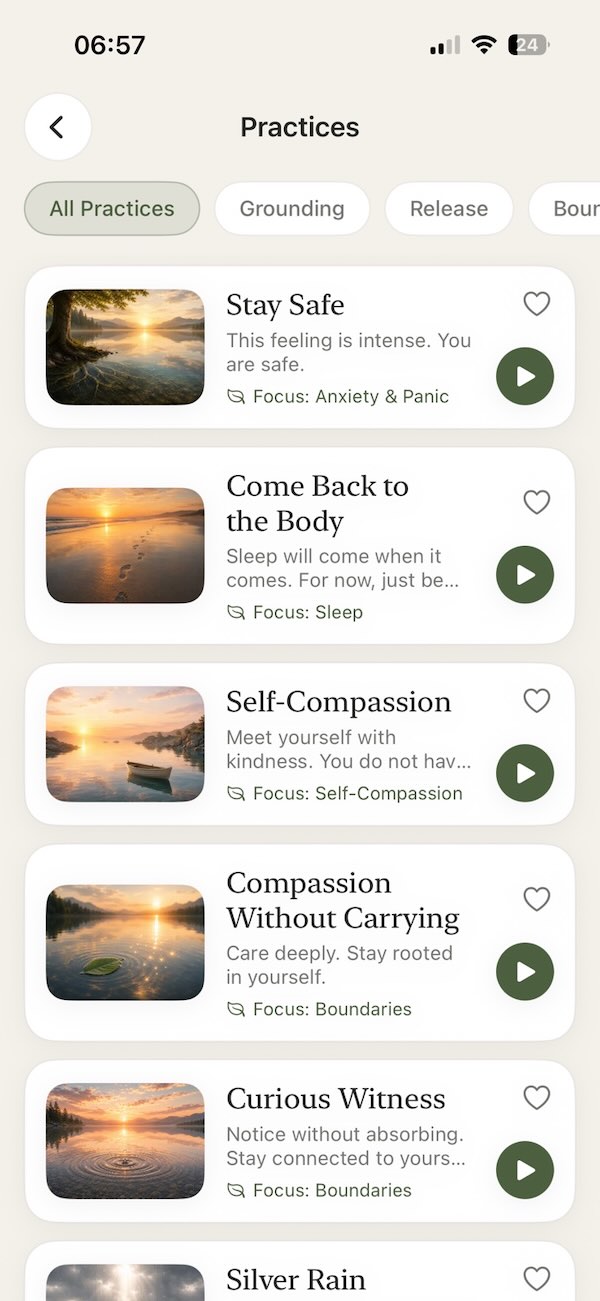
Learning to live alongside loss asks for patience with yourself, not pressure. Self-Compassion is a gentle practice for the long road of carrying grief — a way to meet yourself with kindness as you rebuild, let joy back in without guilt, and move forward while carrying what you love.

Try the practice
Self-Compassion
Offer yourself the kindness you need.
Ready for more support?
Continue your journey in Aira
Access the full library of guided practices, tools, and resources anytime, anywhere.
- 10+Guided Practices
- AnxietyRelief Tools
- SleepSupport
- TrackYour Progress
- OfflineAccess
Available on iPhone and iPad