Panic Attacks at Work: How to Get Through Them and Stay Grounded
How to move through a panic attack at work — what to do in a meeting, when to step away, and why a workplace panic attack says nothing about your competence.

Few places feel more difficult for a panic attack than work. You're surrounded by people, responsibilities still need attention, meetings continue, emails keep arriving. And while your nervous system is sounding an alarm, the world around you often expects you to keep functioning normally.
If you've experienced a panic attack at work, you're not alone. Many people experience workplace panic attacks at some point in their lives, and while they can feel overwhelming, there are ways to move through them safely and compassionately.
What does a panic attack at work feel like?
A panic attack during work often feels especially intense because there's pressure to keep functioning. You may suddenly notice a racing heart, chest tightness, dizziness, shaking, nausea, sweating, difficulty concentrating, feeling detached from your surroundings, or fear of losing control. Alongside the physical symptoms, another layer of anxiety often appears: "What if people notice? What if I can't finish my work? What if I embarrass myself? What if I have to leave?" This secondary fear can make workplace panic feel even more overwhelming.
Why do panic attacks happen at work?
Work combines many things the nervous system naturally finds challenging — responsibility, deadlines, performance expectations, uncertainty, decision-making, social interaction, and evaluation by others. For many people, anxiety and panic at work build gradually rather than appearing suddenly. The nervous system may be carrying chronic stress, emotional exhaustion, perfectionism, burnout, fear of making mistakes, or pressure to perform, until eventually the alarm system activates. The panic attack is often a sign that the nervous system has been carrying more than it can comfortably manage.
Work stress and panic
Work stress panic attacks are surprisingly common. Sometimes the trigger is obvious — an important presentation, a difficult meeting, a conflict with a coworker, a heavy workload. Other times, panic seems to appear without warning while you're answering emails or completing routine tasks. This doesn't mean you're weak; it often means your nervous system has been under pressure for longer than you realized.
How to handle a panic attack at work
If panic is happening right now, try not to focus on making it disappear immediately. Instead, focus on helping your nervous system feel safe.
Step 1: Pause
If possible, stop what you're doing for a moment. You don't need to solve everything right now — you only need to get through the next few minutes.
Step 2: Ground yourself
Notice your feet on the floor, the chair supporting you, the sounds around you, objects you can see. Grounding helps reconnect you with the present moment.
Step 3: Slow your breathing
Try inhaling for 4 seconds and exhaling for 6. Don't force deep breathing — gentle breathing is enough.
Step 4: Remind yourself what's happening
Try saying: "This is a panic attack. My nervous system is activated. This will pass. I am safe enough right now." These reminders can help reduce fear about the symptoms themselves.
What if you're in a meeting?
Many people fear having a panic attack during a meeting. If it happens, focus on breathing slowly, place both feet on the floor, allow yourself to listen rather than perform, and excuse yourself briefly if needed. Most people are far less aware of what you're experiencing than you imagine — what feels obvious to you is often invisible to others.
What if you need to leave?
Sometimes stepping away is the most supportive choice. You might go to the restroom, take a short walk, step outside, or find a quiet space. Taking a brief break is not failure — it's nervous system care. Many people return and continue their day successfully after giving themselves a few minutes to regulate.
The fear of being observed
A panic attack in an office often creates fears about being watched. Remember that panic attacks are internal experiences. Although you may feel highly visible, most people around you are focused on their own work, and the symptoms usually feel much more noticeable to you than they appear externally.
The fear of another panic attack
For many people, the hardest part isn't the first workplace panic attack — it's returning afterward. You may begin worrying: "What if it happens again? What if next time is worse? What if I can't cope?" This fear is understandable, but recovery often begins when you gradually learn that you can survive panic without completely avoiding work. Each time you return, your nervous system learns something important: "I can handle difficult moments."
When work is contributing to panic
Sometimes workplace panic isn't just about the panic itself — it may be a signal that something needs attention. Questions worth asking include: Am I chronically stressed? Am I carrying too much responsibility? Am I sleeping enough? Am I constantly in performance mode? Am I approaching burnout? Panic is not always the problem; sometimes it's the messenger.
Supporting yourself afterward
After the panic passes, you may feel exhausted, emotionally drained, embarrassed, frustrated, or worried. Try to respond with kindness rather than criticism — your nervous system has just worked very hard. Drink some water, take a short walk, slow down where possible, and offer yourself the same understanding you'd offer a friend.
The fuller picture
The most damaging thought in a workplace panic attack is usually this: if I'm panicking at work, it means I can't handle my job — I'm not capable, and now everyone will see it. It feels true because work is where you're evaluated, so a body in visible crisis seems like proof, in front of the exact people whose judgement you fear, that you're not up to it.
But a panic attack measures the load your nervous system is carrying, not your competence. It's a physiological alarm firing — the same false alarm that fires anywhere — not a performance review, and it has no idea whether you're good at your job. Plenty of highly capable, successful people have panicked at work; the panic didn't expose a hidden incompetence, because there wasn't one to expose. Two of the fears quietly fold in on themselves: the sense of being watched is mostly internal — colleagues are absorbed in their own screens, and panic is far less visible than it feels — and the panic itself is often a messenger rather than the problem, a signal that chronic stress, over-responsibility, or burnout has been building. So the honest reading of an attack at work isn't "I can't cope" — it's "my system has been carrying too much." Panic is an experience, not an identity, and not a verdict on your work.
Final thoughts
A panic attack at work can feel frightening, embarrassing, and isolating. It can make you question yourself, your abilities, your confidence, your future. But a panic attack is not proof that you're failing — more often, it's evidence that your nervous system has been carrying a lot. You don't need to be perfect, and you don't need to force yourself through every moment. You only need to take the next step. One breath. One email. One meeting. One grounded moment at a time.
Try a gentle practice
When panic appears at work, it can feel as though everything is happening at once — the emails, the conversations, the deadlines, the pressure to keep going. For a moment, see if you can step out of the rush and reconnect with what's here right now. Ground is a gentle grounding practice for moments when panic, stress, and workplace demands leave you feeling overwhelmed or disconnected — a way to find your footing and return to the present.

Try the practice
Ground
Let's come back to what's real
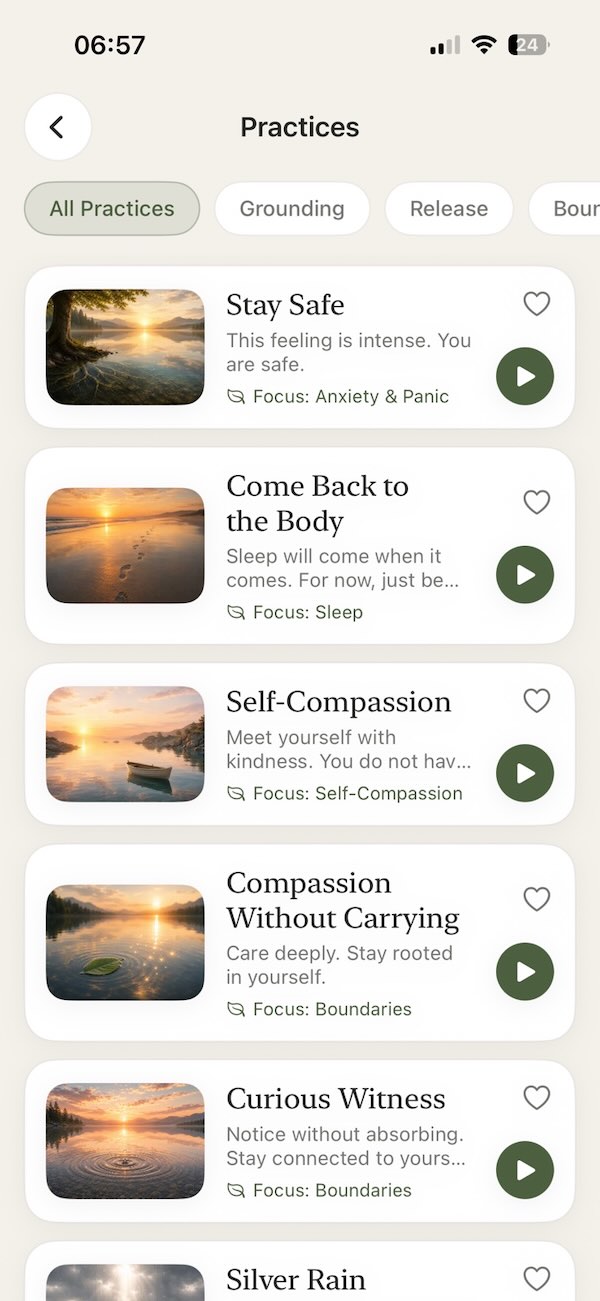
Ready for more support?
Continue your journey in Aira
Access the full library of guided practices, tools, and resources anytime, anywhere.
- 10+Guided Practices
- AnxietyRelief Tools
- SleepSupport
- TrackYour Progress
- OfflineAccess
Available on iPhone and iPad