Parental Burnout: When Parenting Leaves You Empty
What parental burnout is, why modern parenting is so depleting, the signs and the guilt around them, and why exhausted parents deserve care too.

Parenting is relentless in a way few things are — emotionally, physically, around the clock, for years. And while it's filled with love, it can also empty you out completely. Parental burnout is real, increasingly recognised, and far more common than the silence around it suggests. If you love your children and are also exhausted, depleted, and quietly running on empty, you're not a bad parent — you may be burning out.
This is a guide to parental burnout: what it is, why it happens, and why exhausted parents need care too.
What is parental burnout?
Parental burnout is a state of intense exhaustion related to parenting — a sense of being emotionally and physically depleted by it, often accompanied by emotional distancing from your children and a feeling that you're no longer the parent you want to be. It's distinct from ordinary tiredness; it's a deep depletion specific to the relentless demands of raising children, and it can affect any parent, however much they love their kids.
Why parenting is so depleting
Parenting burns people out for structural reasons. It's constant — there are no days off, and the responsibility never fully lifts. It's emotionally demanding, asking for patience and presence even when you have none left. It often comes alongside work and everything else, with little recovery. Modern parenting also carries enormous pressure to do it 'perfectly,' frequently without the village of support people once had. The result is a load that's genuinely larger than one or two people can easily carry.
The signs, and the guilt around them
Parental burnout shows up as exhaustion that sleep doesn't fix, irritability and a short fuse with your kids, emotional detachment or going through the motions, and a sense of failing as a parent. What makes it especially heavy is the guilt: the feeling that being depleted or resentful means you're a bad parent or don't love your children enough. You can love your children with all your heart and still be utterly burnt out — the two aren't contradictions, and the burnout is not evidence of a failure of love.
Why self-criticism makes it worse
Burnt-out parents are often their own harshest critics, piling shame on top of exhaustion — good parents don't feel like this. But this self-criticism drains the little energy that's left and makes everything harder. Burnout responds to support and rest, not to shame. Meeting yourself with the understanding you'd offer another exhausted parent isn't letting yourself off the hook; it's what actually helps you recover enough to parent the way you want to. (Quieting the inner critic has its own guide.)
Why parents need care too
You can't pour endlessly into your children from an empty cup. A depleted, burnt-out parent has less patience, presence, and warmth to give — not through any fault, but because depletion is depletion. Looking after yourself isn't taking something from your children; it's part of being able to show up for them. That means accepting help, protecting some rest and some self, lowering impossible standards, and reaching for support. A cared-for parent is better able to care.
The fuller picture
Underneath the exhaustion, one thought does the most damage: if I'm this depleted and resentful, I must be a bad parent who doesn't love my kids enough — good parents don't feel like this. It feels true because the resentment and the short fuse seem to point straight at the love, as if being worn out were proof it's gone missing.
But burnout measures the load, not the love. Exhaustion and devotion aren't opposites that cancel out — they sit side by side, and you can be utterly wrung out precisely because you care so much and carry so much, for so long, often without the support parents were never meant to go without. The resentment isn't a leak in your love; it's the sound of a system running on empty. And good parents don't feel like this is simply false — it measures you against an airbrushed, village-less standard that modern parenting invented and no real parent meets. Notice, too, what the self-blame costs: shame burns the very energy you need to parent the way you want to, so the verdict quietly makes itself more true. Being burnt out doesn't mean you're failing your children or loving them less. It means you're a loving parent who needs care too — and tending to yourself is part of parenting, not a betrayal of it.
Final thoughts
If parenting has left you empty, it doesn't mean you're failing or that you love your children any less — it means you're carrying an enormous, relentless load, often with too little support. You deserve care, rest, and understanding as much as anyone, and tending to yourself is part of parenting well, not a betrayal of it. Be gentle with yourself, lower the impossible bar, and let yourself be supported. One kind word to yourself, one accepted bit of help at a time.
Parental burnout can be genuinely overwhelming — if it persists or you feel you're struggling to cope, reaching out to a doctor, a professional, or other parents is a strong and sensible step.
Try a gentle practice
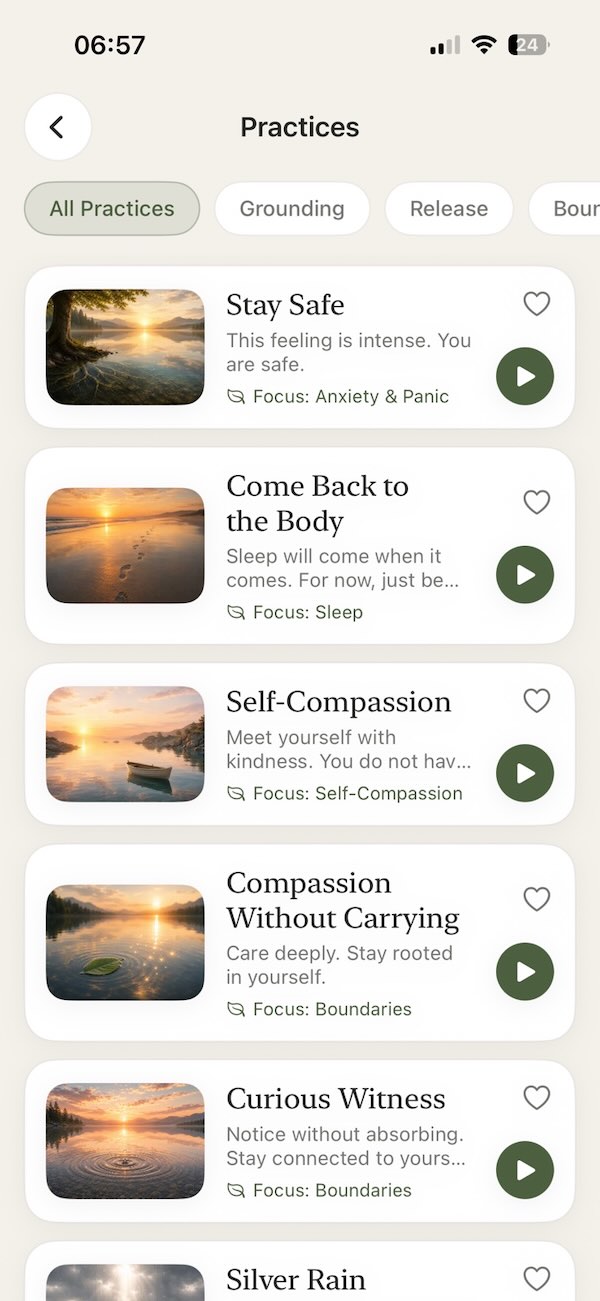
Burnt-out parents are often crushed by guilt and self-criticism that only deepen the exhaustion. Self-Compassion is a gentle practice for exactly that — a way to meet your own struggle with the warmth you'd give another tired parent, ease the guilt, and treat yourself as someone who's doing something hard and deserves care.

Try the practice
Self-Compassion
Offer yourself the kindness you need.
Ready for more support?
Continue your journey in Aira
Access the full library of guided practices, tools, and resources anytime, anywhere.
- 10+Guided Practices
- AnxietyRelief Tools
- SleepSupport
- TrackYour Progress
- OfflineAccess
Available on iPhone and iPad