Caregiver Burnout: When Caring for Others Empties You
What caregiver burnout and compassion fatigue are, why caring for others is so depleting, the signs to watch for, and why caregivers need care too.

Caring for someone who needs you — an ill or ageing relative, a child with extra needs, a struggling partner — can be deeply meaningful. It can also be relentless, and over time it can empty you out completely. Caregiver burnout is the physical, emotional, and mental exhaustion that comes from caring for others, often while neglecting yourself. If you're worn down by caregiving and feeling guilty even for noticing, this is for you.
This is a guide to caregiver burnout: what it is, why it happens, and why the carer needs care too.
What is caregiver burnout?
Caregiver burnout is a state of deep exhaustion — physical, emotional, and mental — that builds in people who care for others over a sustained period. It often comes with a closely related experience, compassion fatigue: the depletion that results from continually attending to someone else's suffering. Both leave you drained, detached, and running on empty, frequently while you keep caring anyway, because someone is depending on you.
Why caregiving is so depleting
Caregiving burns people out for specific reasons. It's often constant, with no clear time off and no obvious end. It's emotionally heavy — you're managing not just tasks but worry, grief, and someone else's distress. It frequently lands on top of the rest of life, not instead of it. And caregivers routinely put their own needs last, skipping rest, meals, and support to keep going. The result is a slow, near-total depletion that builds precisely because the caring can't easily stop.
The signs of caregiver burnout
Caregiver burnout shows up as overwhelming exhaustion; irritability or resentment toward the person you're caring for (often followed by guilt); withdrawing from others; neglecting your own health; feeling hopeless or trapped; and getting ill more often. A particularly painful sign is emotional numbness or detachment toward someone you love — not a sign you've stopped caring, but a sign you're running on empty.
The guilt that keeps caregivers stuck
Many caregivers won't rest or ask for help because of guilt — a feeling that any time spent on themselves is taken from the person who needs them, or that struggling means they're failing. This guilt is understandable but harmful: it drives caregivers to deplete themselves completely, which ultimately makes them less able to care. Acknowledging your own limits and needs isn't selfish or a betrayal; it's part of being able to keep caring at all.
Why the caregiver needs care too
You cannot pour endlessly from an empty cup. A depleted caregiver — exhausted, resentful, unwell — can't provide the care they want to, and may eventually be unable to provide it at all. Looking after yourself isn't a luxury stolen from the person you care for; it's what makes sustained caring possible. That means accepting help, taking real breaks, protecting some of your own time and health, and reaching out for support — whether from others who can share the load or from services and communities built for carers.
The fuller picture
The thought that keeps a caregiver depleting themselves is usually this: if I resent this, or need a break, I'm failing the person who depends on me — a good person wouldn't feel this way, and any time I take for myself is stolen from them. It feels true because someone genuinely needs you, so resting can look like abandoning them, and resentment can look like proof your love has run out.
But resentment and numbness measure depletion, not love. You can love someone deeply and still be worn to nothing by the relentless work of caring for them — the exhaustion sits alongside the love, it doesn't replace it, and the flatness you feel toward someone you love is the empty tank talking, not a verdict on your heart. And the maths of "time for myself is stolen from them" is simply wrong: it treats care as zero-sum, when a depleted carer has less to give, not more. Rest isn't subtracted from the person you love — it's what keeps you able to care for them at all. Notice what the guilt actually does: it drives you to give until there's nothing left, which is the one outcome that truly would fail them. So needing a break isn't the failure. It's the signal of someone who has been carrying, with love, more than any one person can carry alone — and who is allowed to be cared for too.
Final thoughts
If you're burning out as a caregiver, it isn't because you don't care enough — it's because you care deeply and have been giving more than any one person can sustainably give. You deserve care as much as the person you're looking after, and tending to yourself is part of caring for them, not a betrayal of it. Please be gentle with yourself, accept what help you can, and don't carry it entirely alone. One accepted break, one shared bit of the load at a time.
Caregiving can be genuinely overwhelming, and reaching out to a doctor, a support service, or others who understand is a strength, not a failure.
Try a gentle practice
Caregivers rarely let themselves stop, even when they're running on empty. Permission to Rest is a gentle practice for exactly that — a way to let yourself pause and be cared for, just for a few moments, without guilt, and to remember that you're allowed to rest even when someone needs you.

Try the practice
Permission to Rest
You've done enough. You're allowed to rest.
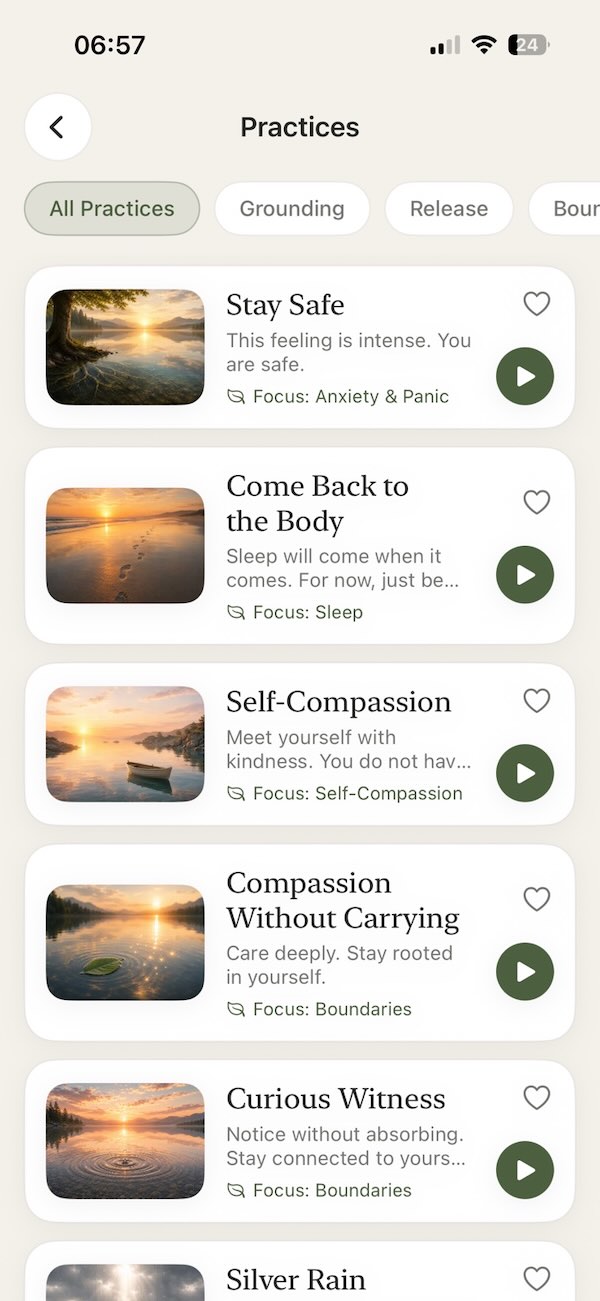
Ready for more support?
Continue your journey in Aira
Access the full library of guided practices, tools, and resources anytime, anywhere.
- 10+Guided Practices
- AnxietyRelief Tools
- SleepSupport
- TrackYour Progress
- OfflineAccess
Available on iPhone and iPad