Secondhand Stress: Why You Absorb Other People's Tension
What secondhand stress is, why we absorb other people's tension, why it's so easy to miss, and how to stay close to people without taking on a stress that was never yours.

You walk into a room and, within moments, you've caught the mood. Someone near you is wound tight, and now your own shoulders are up, your chest is a little braced, your day has quietly tilted — even though nothing happened to you. This is secondhand stress: the tension you pick up from other people, as real and as physical as your own, even though it started in someone else's nervous system. And if you're sensitive to it, it can be one of the biggest and least obvious sources of the background tension you carry.
This is a guide to secondhand stress: what it is, why we absorb other people's tension, why it's so easy to miss, and how to stay connected without taking on a stress that was never yours.
What is secondhand stress?
Secondhand stress is the stress you absorb from the people around you rather than generate yourself. Just as secondhand smoke affects people who never lit a cigarette, another person's anxiety, tension, or bad mood can raise your own stress level without any threat of your own. It travels through tone of voice, facial expression, body language, and a hundred signals you read without noticing. The result is that you end up tense, on edge, or drained — and because there's no event of your own to point to, it feels like it came from nowhere.
Why we absorb other people's stress
Humans are wired to catch each other's emotions. It's called emotional contagion, and it happens largely automatically: your brain reads the state of the people around you and, to a degree, mirrors it. This is an ancient social feature — it's how groups stay attuned and how we empathise at all — but it means distress is contagious too. When someone near you is activated, part of your system activates in sympathy.
Some people absorb more than others. If you're highly sensitive or naturally empathetic, you pick up on subtle cues most people miss, which makes you especially prone to taking on others' states. And the closer the relationship, the stronger the effect — research suggests we absorb stress from partners and family far more powerfully than from strangers. The people you love most are the ones whose tension you're most likely to be carrying.
Why it's so easy to miss
The tricky thing about secondhand stress is that it doesn't announce itself as theirs. You don't think I'm picking up my partner's anxiety; you just feel tense, and your mind, needing an explanation, often reaches for one of your own — maybe I'm anxious, maybe something's wrong with me. The stress has crossed over so seamlessly that it feels homegrown. This is exactly why it can run for years undetected: you experience the effect, but you never trace it back to the source. The first real step is simply knowing this happens, so that when tension rises for no reason of your own, you can ask a new question: whose is this?
How secondhand stress builds background tension
On its own, catching someone's mood for an hour is harmless — it passes. The problem comes when the exposure is constant: living with someone chronically stressed, working beside someone always on edge, being the person everyone brings their distress to. Then you're absorbing activation faster than you can discharge it, and it stops being an occasional spike and becomes a baseline. You brace a little all the time, without ever deciding to. This is one of the quiet ways a person ends up tense around the clock with no personal reason they can name — they're carrying a tension that was never theirs to begin with.
How to stop absorbing it
You can't switch off emotional contagion — nor would you want to lose the empathy underneath it — but you can stop it from flattening you. The single most useful move is to separate what's yours from what isn't. When tension rises, pause and ask: whose feeling is this? Naming a state as someone else's loosens its grip immediately, because you stop treating their weather as your own.
From there, it helps to shift from absorbing to witnessing. You can be fully present with someone who's struggling — care about them, stay warm — without taking their state into your body. Witnessing is sustainable; absorbing is not. It also helps to protect your exposure where you can, and to actively discharge what you've picked up: a slow exhale, a little movement, stepping outside for a moment, so the activation you absorbed has somewhere to go instead of settling in. None of this makes you colder. It's what lets you stay close to people without dissolving into their stress.
The fuller picture
Underneath the absorbing is usually one quiet belief: if I really care about this person, I have to feel what they feel — staying calm while they're stressed would mean I'm cold or checked-out. It feels true because the tension arrives so automatically that catching it seems like the same thing as caring.
But absorbing and caring are not the same act, and the difference is the whole story. You can feel with someone while the stress stays theirs, or you can take it into yourself until their activation is your activation — and the second one doesn't help them at all. A person calming down beside a steady presence has something to borrow; a person calming down beside someone who's now just as wound-up as they are has nothing. So staying steady while someone you love is stressed isn't abandonment — it's the most useful thing you can offer, because your calm is contagious too. The question that gives the excess back is always the same: whose feeling is this? You can care deeply, stay present, and still let the other person's stress remain theirs. That's not caring less. It's how you get to keep caring without being emptied by it.
When to seek support
If you're constantly absorbing stress from someone close and can't find your own baseline — or if living or working alongside another person's tension is wearing down your sleep, mood, or health — it's worth getting support. A therapist can help you build the internal separation that keeps you from merging with others' states, especially if you learned early that other people's feelings were yours to manage. Absorbing too much, for too long, is a real strain, and it responds well to help.
Final thoughts
Secondhand stress is real, and if you're the kind of person who feels everything, you may have been carrying far more of it than you realised — years of other people's tension quietly filed as your own. The goal isn't to stop caring or to wall yourself off; it's to keep your open heart while letting other people's stress stay theirs. You can be close, warm, and deeply attuned, and still not take the weight into your body. One whose feeling is this?, one steady breath, one bit of borrowed tension handed back at a time.
Try a gentle practice
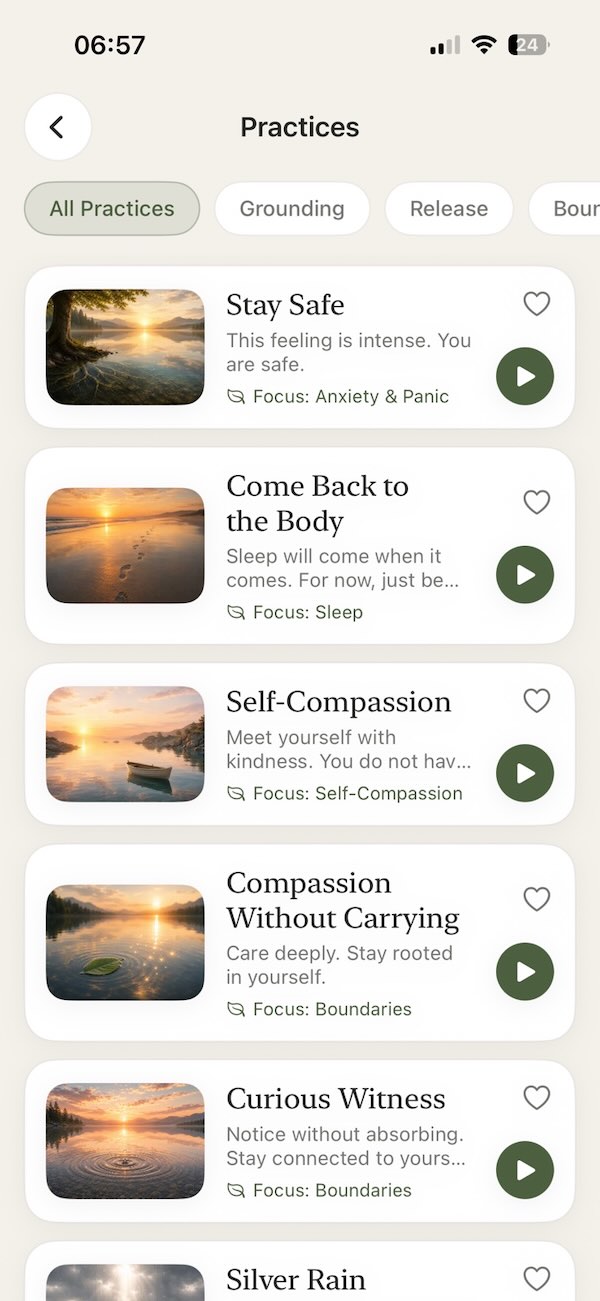
At the heart of secondhand stress is taking on what was never yours to hold. Compassion Without Carrying is a gentle practice for exactly that — a way to stay warm and present with the people you love while letting their stress and emotions remain theirs, so you can care fully without absorbing it all.

Try the practice
Compassion Without Carrying
Care without losing yourself.
Ready for more support?
Continue your journey in Aira
Access the full library of guided practices, tools, and resources anytime, anywhere.
- 10+Guided Practices
- AnxietyRelief Tools
- SleepSupport
- TrackYour Progress
- OfflineAccess
Available on iPhone and iPad