Empath Burnout: When Caring Too Much Drains You
What empath burnout is, the signs of empath fatigue, why absorbing others' emotions exhausts you, and how boundaries help empaths care without burning out.

If you're the kind of person who feels other people's emotions as if they were your own — who walks out of a room carrying everyone's mood, who simply can't not care — you already know it can be a lot. Empaths give enormous amounts of emotional energy, often without realising it, and over time that can lead somewhere specific: empath burnout, a deep emotional exhaustion that comes from absorbing and caring too much, for too long, without enough protection or recovery.
This is a guide to empath burnout: what it is, how to recognise it, why it happens, and how boundaries let you keep your empathy without being flattened by it.
What is empath burnout?
Empath burnout is emotional and physical exhaustion that builds up in people who are highly empathetic — those who naturally absorb others' feelings and pour out care. Where ordinary burnout often comes from overwork, empath burnout comes from over-feeling: taking on emotion after emotion, problem after problem, until your own reserves are empty. It's closely related to compassion fatigue, the depletion that comes from caring for others in distress. The defining experience is being drained by other people — even ones you love — and having nothing left for yourself.
Signs of empath burnout
Empath fatigue creeps up gradually. Common signs:
- You feel constantly drained, especially after time with people.
- You're emotionally numb or flat, where you used to feel deeply.
- You're more irritable or resentful toward people who need you.
- You dread social contact you'd normally welcome.
- You can't tell your own feelings apart from everyone else's anymore.
- Small emotional demands feel like far too much.
- You feel guilty for needing space, and exhausted when you don't get it.
If several of these are familiar, you may be running on empty — not because you care too little, but because you've cared without refuelling.
Why empaths burn out
Empaths burn out for a specific reason: they absorb emotions rather than just witnessing them, and they often have weak boundaries around it. Without a clear line between their feelings and yours, every encounter deposits more emotional weight onto you — and if you also believe it's your job to fix, soothe, and carry, the load never gets put down. Add a culture that praises endless giving and rarely models rest, and depletion becomes almost guaranteed. The problem was never your empathy; it's empathy without protection.
Empath burnout and boundaries
The way out isn't to stop caring — it's to care with boundaries. For an empath, boundaries are what stand between sustainable compassion and total depletion. That means learning to witness others' emotions without absorbing them, to support without carrying, and to protect your own energy and recovery without guilt. Boundaries don't make you less empathetic; they're what let your empathy last. An empath with boundaries can keep their open heart precisely because they're no longer bleeding energy from it day and night.
How to recover from empath burnout
Recovery is about refilling and protecting what was drained.
Rest and refuel first
Acute empath burnout needs genuine recovery — solitude, rest, and time away from emotional demand. You can't pour from empty.
Separate your feelings from others'
When you feel flooded, ask: whose feeling is this? Giving back what isn't yours is one of the most protective skills an empath can learn.
Protect your energy proactively
Decide in advance how much you can give, and to whom. Empath self-care means limits set before you're depleted, not after.
Care without carrying
You can be present and compassionate without taking the other person's emotions onto yourself. Witnessing is sustainable; absorbing is not.
The fuller picture
Driving the depletion is one belief: it's my job to feel it all — to absorb, soothe, fix, and carry everyone's emotions — and caring less would mean I don't really care. It feels true because the feelings arrive so automatically that absorbing them seems like the same thing as compassion.
But absorbing and witnessing are not the same act, and the difference is the whole story. Witnessing is feeling with someone while the emotion stays theirs; absorbing is taking it into yourself until their weight is your weight, deposited encounter after encounter with nowhere to go. Your empathy was never the problem — empathy without protection is. And the belief that you must carry it all in order to truly care has it backwards: an empath who absorbs everything eventually goes numb, irritable, and empty, with nothing left to give, while an empath with boundaries gets to keep an open heart precisely because it isn't bleeding energy day and night. There's one question that gives the excess back: whose feeling is this? You can care deeply, stay present, and still let other people's emotions remain theirs. Protecting your energy isn't caring less. It's how the caring gets to last.
Final thoughts
Empath burnout isn't a sign that something is wrong with your caring heart — it's a sign that your empathy has been running without protection. Your sensitivity to others is a gift, but a gift you have to safeguard, or it will quietly empty you. You're allowed to rest, to give less than everything, and to keep some of your care for yourself. The world needs empaths who are replenished, not depleted — and the boundaries that protect you are also what let you keep showing up. One refilled reserve, one whose feeling is this?, one protected limit at a time.
Try a gentle practice
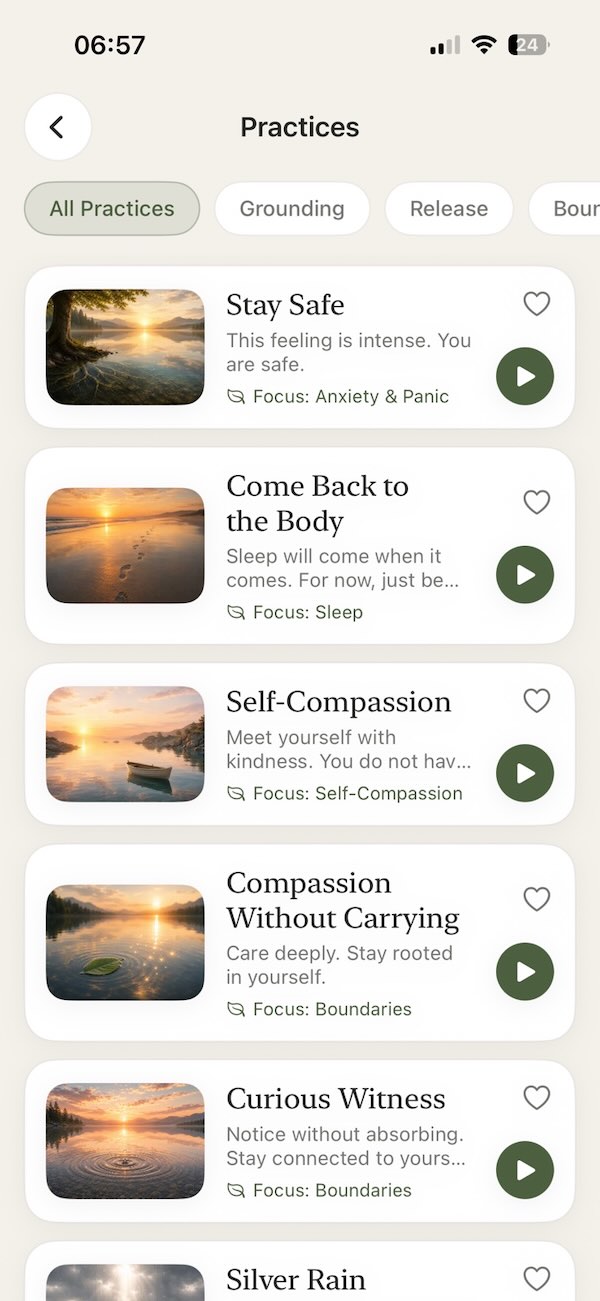
At the heart of empath burnout is absorbing what was never yours to carry. Compassion Without Carrying is a gentle practice for exactly that — a way to keep your empathy and care fully alive while letting other people's emotions remain theirs, so you can stay open-hearted without being drained dry.

Try the practice
Compassion Without Carrying
Care without losing yourself.
Ready for more support?
Continue your journey in Aira
Access the full library of guided practices, tools, and resources anytime, anywhere.
- 10+Guided Practices
- AnxietyRelief Tools
- SleepSupport
- TrackYour Progress
- OfflineAccess
Available on iPhone and iPad