Self-Compassion Exercises: Simple Ways to Be Kinder to Yourself
Practical self-compassion exercises you can actually use — the self-compassion break, hand on heart, the friend test, rewording the inner critic, a compassionate letter, and kind wishes.

Self-compassion is a skill, which means it can be practised — and like any skill, it grows through small, repeated exercises rather than one big effort. If the idea of being kinder to yourself feels appealing but vague, this is the practical version: a handful of simple self-compassion exercises you can actually use, especially in the moments self-criticism tends to take over. (For what self-compassion is and why it matters, there's a separate guide; here the focus is the doing.)
A quick note before you start: if any of these feel awkward or undeserved at first, that's normal. Most of us are far more practised at self-criticism than self-kindness, so kindness can feel unfamiliar — not wrong, just new. It gets easier with repetition.
The self-compassion break
This is the most useful exercise to learn first, because it takes under a minute and works in almost any hard moment. When you notice you're struggling, pause and say to yourself, in your own words, three things: first, this is a hard moment — simply naming the difficulty; second, hard moments are part of being human, and I'm not the only one who feels this way — placing it in common humanity rather than personal failure; and third, may I be kind to myself right now — offering yourself some warmth. Three sentences, that's it. The exact wording matters less than the shift it creates: from fighting the moment to meeting it gently.
Hand on your heart
Sometimes the fastest route to self-kindness isn't words but touch. Place a hand on your heart, rest it on your cheek, or wrap your arms around yourself, and feel the warmth and gentle pressure for a few breaths. It can feel slightly strange at first, but the body responds to soothing touch in a similar way whether it comes from someone else or from you — it's a simple signal of safety that can take the edge off distress when words feel like too much.
Talk to yourself as you would a friend
This is the exercise most people find quietly powerful. Think of how you'd speak to a good friend going through exactly what you're going through — the tone, the patience, the words you'd choose. Almost no one says to a struggling friend what's wrong with you, you're so weak. Now offer yourself that same voice. You're not lowering your standards; you're changing the tone you use to hold them. When you catch harsh self-talk, simply ask: would I say this to someone I love? — and if not, try rewording it the way you would for them.
Reword the inner critic
Building on that, you can practise gently translating the critic's lines into something truer and kinder. I'm failing at everything becomes I'm having a really hard day and a few things didn't go well. I should be over this by now becomes this is taking longer than I hoped, and that's okay. The aim isn't fake positivity or pretending things are fine — it's swapping cruelty for honesty delivered with warmth. (If that inner voice is especially loud, there's a dedicated guide to working with the inner critic.)
Write yourself a compassionate letter
When something weighs on you, try writing a short letter to yourself from the perspective of a kind, understanding friend who knows everything you're going through. Let them acknowledge how hard it is, remind you that you're human, and offer encouragement without judgment. Reading it back can shift how you relate to the situation — and unlike a passing thought, a letter is something you can return to on the next hard day.
Offer yourself a few kind wishes
Borrowed from loving-kindness practice, this one is simple: silently offer yourself a few gentle phrases, such as may I be kind to myself, may I give myself the patience I need, may I be at ease. Choose words that feel genuine rather than forced. Repeating a couple of them slowly, especially paired with the breath, is a small daily way to build a warmer default toward yourself over time.
Make it a small daily habit
None of these exercises needs to be long or dramatic to work. A single kinder sentence in a hard moment is a real practice, and the benefit comes from repetition more than intensity. You might pair one with something you already do — a self-compassion break on the commute, a hand on the heart before sleep, rewording one harsh thought a day. Small and consistent beats big and occasional.
Try a gentle practice
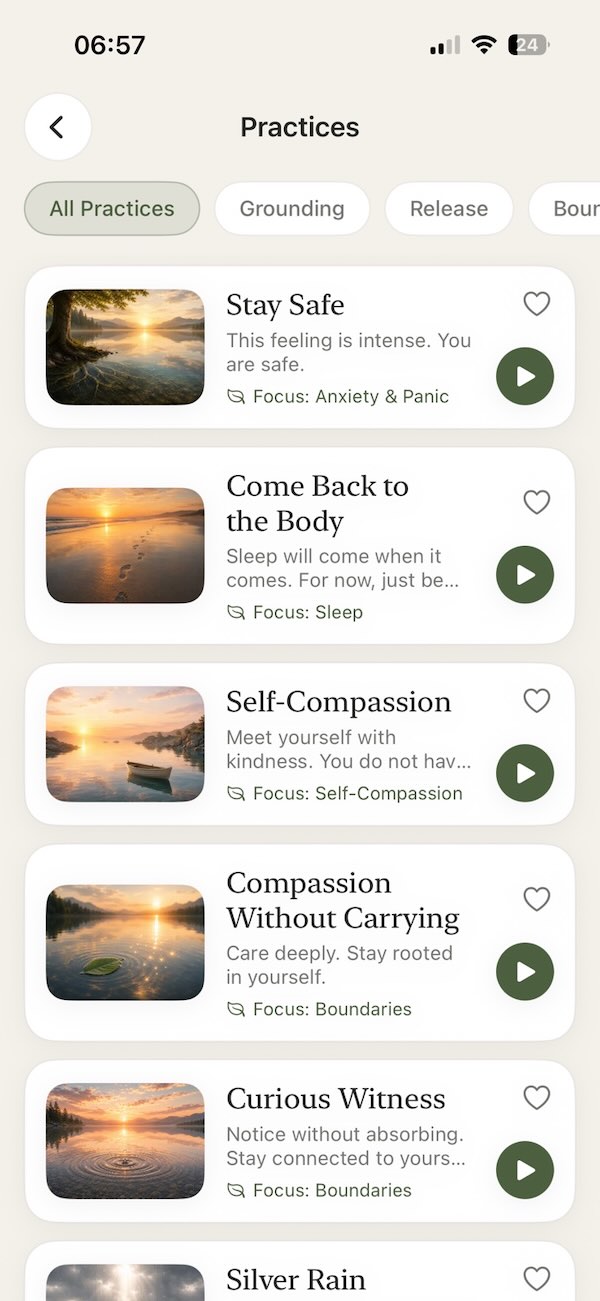
If guiding yourself feels like a lot, it's often easier to be led — especially when self-criticism is loud and kindness feels out of reach. Self-Compassion is a gentle guided practice that walks you through exactly this: softening the inner pressure, acknowledging your experience honestly, and offering yourself the warmth you'd give a friend.

Try the practice
Self-Compassion
Offer yourself the kindness you need.
Ready for more support?
Continue your journey in Aira
Access the full library of guided practices, tools, and resources anytime, anywhere.
- 10+Guided Practices
- AnxietyRelief Tools
- SleepSupport
- TrackYour Progress
- OfflineAccess
Available on iPhone and iPad