Social Anxiety: Why Being Around People Feels So Hard
Why ordinary social moments can feel so hard — what social anxiety is, how it differs from shyness, the cycle that keeps it going, and gentle ways to ease it.

For some people, the hardest situations aren't dangers or disasters — they're ordinary social moments. Speaking up in a meeting. Walking into a room where you don't know anyone. Making small talk. Being watched, judged, or simply noticed. If being around people can leave you tense, self-conscious, and drained, you may be experiencing social anxiety — and you're far from alone.
Social anxiety is one of the most common forms of anxiety, and understanding how it works is the first step toward loosening its hold.
What is social anxiety?
Social anxiety is an intense fear of being judged, embarrassed, or negatively evaluated in social situations. It's more than ordinary shyness or the occasional nerves before a presentation. With social anxiety, the fear can feel overwhelming, show up well in advance, and lead you to avoid the very situations that matter to you. At its core is a deep worry about how you come across to others — and a conviction that you'll be found lacking.
What social anxiety feels like
Social anxiety is physical as much as mental. In feared situations you might notice a racing heart, blushing, sweating, a shaky voice, a dry mouth, nausea, or a mind that suddenly goes blank. Alongside the body sensations come the thoughts: "everyone's looking at me," "I'll say something stupid," "they can tell I'm anxious," "I'm embarrassing myself." The fear of others noticing your anxiety often becomes its own source of anxiety.
Common social anxiety triggers
Social anxiety can attach to all kinds of situations: speaking in groups or meetings, meeting new people, being the centre of attention, eating or drinking in front of others, making phone calls, dating, parties, or even being watched while you work. What these share is the possibility of being observed and judged. Many people fear some situations intensely and barely notice others.
Why social anxiety happens
Social anxiety usually grows from a mix of factors: a naturally sensitive temperament, past experiences of embarrassment, criticism, or rejection, and a nervous system that has learned to treat social attention as a threat. Underneath it is a very human need — to belong and be accepted — paired with a fear that acceptance is at risk. The brain, trying to protect you from rejection, sounds the alarm in situations where you might be judged.
The anxiety cycle in social situations
Social anxiety tends to feed itself. You anticipate a situation and dread it. In the moment, you become hyper-aware of yourself — monitoring your voice, your face, your every word — which makes you feel more self-conscious and less present. Afterward, you replay it, scanning for everything you did 'wrong'. Each stage strengthens the belief that social situations are dangerous, which feeds the dread next time. The self-focus meant to protect you actually keeps the fear alive.
Social anxiety and avoidance
The most natural response to social fear is to avoid — declining invitations, staying quiet, leaving early, or relying on a drink to get through. Avoidance brings instant relief, which is why it's so hard to resist. But it also teaches the brain that the situation really was dangerous and that you only coped because you escaped. Over time, avoidance shrinks your world and strengthens the anxiety. Gently reducing it, in small steps, is one of the most powerful ways forward.
How to ease social anxiety
Shift attention outward
Social anxiety thrives on self-monitoring. Deliberately moving your attention outward — onto the other person, the conversation, the room — reduces self-consciousness and helps you feel more present.
Question the spotlight
We tend to assume others are watching and judging us closely. In reality, most people are far more focused on themselves. Reminding yourself of this 'spotlight effect' can take some of the pressure off.
Reduce avoidance gradually
Approaching feared situations in small, manageable steps teaches your nervous system that they're survivable — and usually far less catastrophic than predicted.
Be kind to yourself afterward
Resist the urge to replay and criticise. A gentler review — "that was hard, and I did it" — helps far more than harsh self-judgment.
Calm the body
Slowing the breath and grounding before and during social situations helps settle the physical surge, making the experience more manageable.
The fuller picture
The thought at the centre of social anxiety usually sounds like this: everyone can see how anxious and awkward I am, and they're all judging me for it. It feels completely real, because anxiety turns your attention inward and magnifies every flush, pause, and stumble — from the inside, it feels broadcast in high definition.
Here's what that misses. What's loud and obvious to you is almost invisible from the outside — people notice a tiny fraction of what you feel. And the oddly comforting part: most people aren't scoring you at all, because they're busy worrying about their own impression. The spotlight you feel is mostly your own attention, turned on yourself. Point it outward — at the person, the conversation, the room — and much of the fear has nothing left to feed on.
When to seek support
If social anxiety is limiting your relationships, work, studies, or the life you want to live, it's worth speaking with a therapist. Social anxiety is very treatable — cognitive behavioural therapy (CBT), often including gradual exposure, is especially effective. Reaching out isn't a sign of weakness; it's a way to reclaim the situations and connections that matter to you.
Frequently asked questions
What is social anxiety?
Social anxiety is an intense fear of being judged, embarrassed, or negatively evaluated in social situations. It goes beyond ordinary shyness — the fear can feel overwhelming, build up in advance, and lead to avoiding situations that matter to you.
What's the difference between social anxiety and shyness?
Shyness is a temperament — a tendency to feel reserved or slow to warm up — that doesn't usually stop you living your life. Social anxiety is more intense and more disruptive: the fear of judgment can be overwhelming and often leads to avoidance that limits relationships, work, or daily activities.
What causes social anxiety?
It usually grows from a mix of a sensitive temperament, past experiences of embarrassment, criticism, or rejection, and a nervous system that has learned to treat social attention as a threat. At its heart is a very human need to belong, paired with a fear that acceptance is at risk.
How can I calm social anxiety in the moment?
Shift your attention outward onto the other person or the conversation rather than monitoring yourself, slow your breathing, and ground in the present. Remind yourself of the 'spotlight effect' — people are usually far more focused on themselves than on you.
Can social anxiety go away?
It can improve a great deal with the right approach. Social anxiety is very treatable, and CBT with gradual exposure is especially effective — gently reducing avoidance teaches the nervous system that social situations are survivable, and the fear loosens over time.
Try a gentle practice
Social anxiety pulls your attention onto yourself and your perceived flaws. Observe is a gentle practice for stepping back from anxious, self-critical thoughts — a way to watch them with a little distance instead of being swept up in them, so you can return your attention to the present and the people in front of you.

Try the practice
Observe
Let's step back and see more clearly
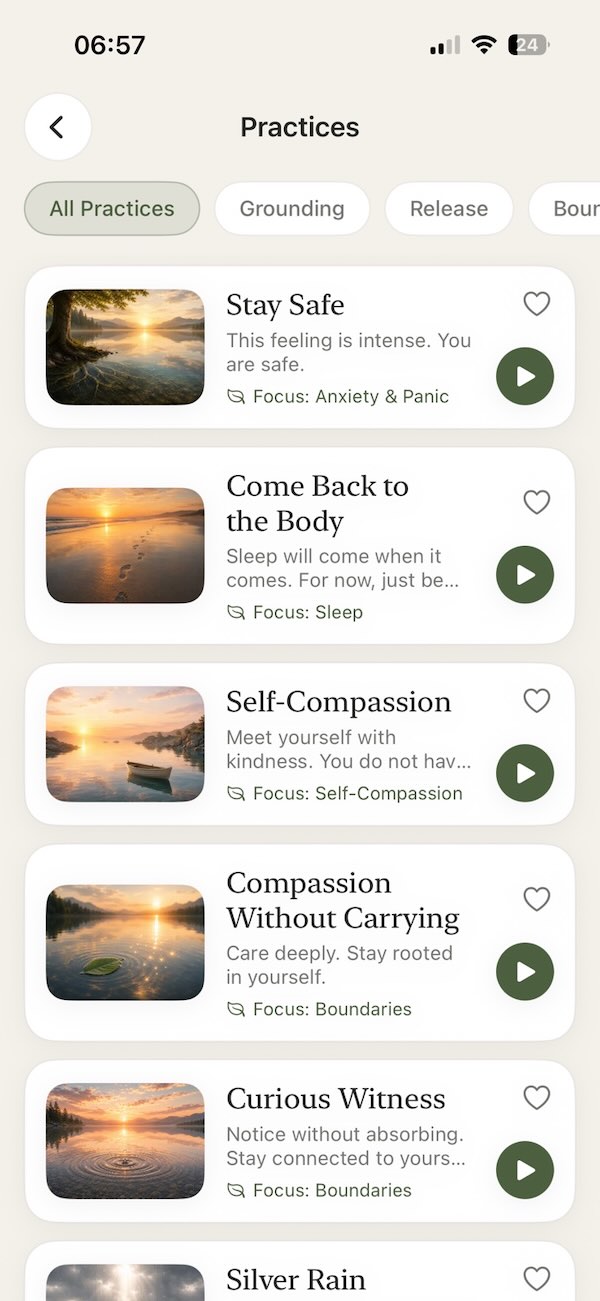
Ready for more support?
Continue your journey in Aira
Access the full library of guided practices, tools, and resources anytime, anywhere.
- 10+Guided Practices
- AnxietyRelief Tools
- SleepSupport
- TrackYour Progress
- OfflineAccess
Available on iPhone and iPad