Why Do I Wake Up Anxious in the Middle of the Night?
Why you wake uneasy and on edge at 3 a.m. even after falling asleep calmly, why it feels so intense in the dark, and gentle ways to settle back into rest.

You fall asleep without much difficulty. The day is over. The lights are off. Everything seems fine. And then suddenly: you're awake. Maybe it's 2 a.m. Maybe it's 3 a.m. Maybe it's 4 a.m. Your eyes open, your body feels alert, and your mind immediately starts searching for explanations. And you find yourself wondering: "why do I keep waking up anxious in the middle of the night?"
If this feels familiar, you're not alone. Many people experience middle-of-the-night anxiety even when they fell asleep without feeling particularly stressed. It can be confusing and unsettling — but in most cases there are understandable reasons why it happens.
What is middle-of-the-night anxiety?
Middle-of-the-night anxiety is waking during the night with a low, nagging sense of anxiety, nervousness, restlessness, or emotional activation. People describe waking up uneasy for no obvious reason, feeling alert when they'd rather be asleep, a mind that switches straight on, and difficulty drifting back off. It's usually a lower-grade hum than a full-blown emergency — more "wide awake and on edge" than "terrified." (If instead you wake in a sudden wave of panic, with a pounding heart and real fear, that's a distinct experience with its own causes and responses, covered in its own article.)
Why does anxiety wake me up?
Many people ask "why is anxiety waking me up?" The answer often involves the nervous system. Sleep is not a completely inactive state — throughout the night your brain and body keep processing emotions, memories, stress, and physical sensations. If your nervous system has been carrying a lot of stress, uncertainty, or emotional pressure, some of that activation can become noticeable during the natural brief awakenings that punctuate normal sleep. In other words, the anxiety didn't necessarily start at 3 a.m. — your awareness of it did.
Why 3 a.m. specifically?
There's a reason so many people name the same hour. Your sleep isn't uniform across the night: the first half is dominated by deep, heavy sleep, while the second half — roughly 3 a.m. onwards — grows lighter and more dream-heavy, with more natural surfacings toward waking. Around the same time, your cortisol, the body's alertness hormone, begins its slow pre-dawn rise, gently priming you to wake for the day. In someone calm, these shifts pass unnoticed. But if your nervous system is already carrying stress, that early cortisol lift can land like an alarm rather than a nudge — and a light, emotionally raw stage of sleep is exactly when a waking mind reaches for worry. It isn't that 3 a.m. holds bad news; it's that 3 a.m. is when your body is most easily tipped from sleep into alertness.
Why anxiety often feels stronger at 3 a.m.
Many people specifically report "I wake up with anxiety at 3 a.m." There's something uniquely difficult about being awake in the middle of the night. The world is quiet, support feels distant, the future feels bigger, and the mind has fewer distractions. A worry that feels manageable during the day can feel overwhelming at 3 a.m. — not because the problem has grown, but because your perspective has narrowed. The nervous system feels more vulnerable when you're tired, alone, and awake while the rest of the world seems asleep.
The search for answers keeps you awake
One of the first things many people do after waking anxious is start thinking. The mind asks why am I awake? what's wrong? did I forget something? what if I can't get back to sleep? what if tomorrow is ruined? The brain begins hunting for certainty — but certainty is hard to find at 3 a.m., and the search itself tends to raise the anxiety. What started as a simple awakening becomes a cycle of worry that keeps you from settling.
Why night waking feels different from daytime anxiety
During the day you have options — you can move, talk to someone, distract yourself, get on with things. At night those options shrink. You're lying in the dark, the room is quiet, and the mind has nowhere to direct its attention except inward. That's part of why the same level of anxiety can feel so much larger at night.
Common contributors
Many things can make anxious awakenings more likely: chronic stress, emotional overwhelm, burnout, uncertainty, major life transitions, poor sleep quality, a lot of stimulation during the day, and ongoing worry. Usually it isn't a single cause — it's the cumulative load the nervous system has been carrying.
What helps when you wake up anxious at night
First, don't assume something is wrong
Many people wake and instantly begin problem-solving. Instead, pause and name it: "I'm awake. I'm feeling anxious. I don't need to solve anything right now."
Return to the body
Notice the mattress beneath you, the blanket on your skin, the rhythm of your breath. Grounding begins with physical awareness, and it gives the mind somewhere to rest other than worry.
Don't check the clock
Clock-checking tends to raise the pressure — the mind starts calculating hours lost and how tired tomorrow will be. None of that helps the nervous system settle.
Let tomorrow wait
Most nighttime worries are future-focused. They'll still be there in the morning if they genuinely need attention. You don't have to carry them at 3 a.m.
The fuller picture
When you wake in the dark and the worries feel enormous, the mind takes the size of the feeling as proof: if it feels this bad at 3 a.m., it must be true — everything really is falling apart. It feels true because the dread is vivid and the night is silent, with nothing to argue against it.
But 3 a.m. is not a neutral vantage point — it's one of the worst possible ones. You're tired, the body's resources are low, it's dark, you're alone, and every distraction that gives daytime worries their proportion has fallen away. So the same concern that felt manageable at noon looms huge at night — not because it grew, but because the lens narrowed. The 3 a.m. mind doesn't show you the truth in sharper focus; it shows you a distorted, magnified version of it. Almost everyone has noticed this: the thought that felt catastrophic in the dark looks ordinary by morning. Nothing was solved overnight — the light just came back. You don't have to believe the 3 a.m. version of your life. Let the hour pass, and look again once the lens has widened.
You are not broken
One of the hardest parts of night-time anxiety is the sense that something is wrong with you. But waking up anxious is a common human experience, especially during stretches of stress, grief, burnout, or change. Your nervous system isn't failing — it may simply be carrying more than it can comfortably process.
Final thoughts
Middle-of-the-night anxiety can feel lonely, and it can make the night seem far longer than it is. But waking up anxious doesn't mean you're in danger, that something is wrong with you, or that you'll always feel this way. Often it's simply a sign that your nervous system is asking for support. Tonight, you don't need to solve the future or force sleep. One breath is enough. One moment of grounding is enough. One gentle return to the present is enough.
Try a gentle practice
Waking anxious in the middle of the night can feel disorienting. Before your mind starts searching for answers or jumping ahead to tomorrow, take a moment to reconnect with where you are right now. Ground is a gentle practice for nighttime awakenings, middle-of-the-night anxiety, and difficulty settling back into rest — a way to return to your body, your surroundings, and the safety of the present moment.

Try the practice
Ground
Let's come back to what's real
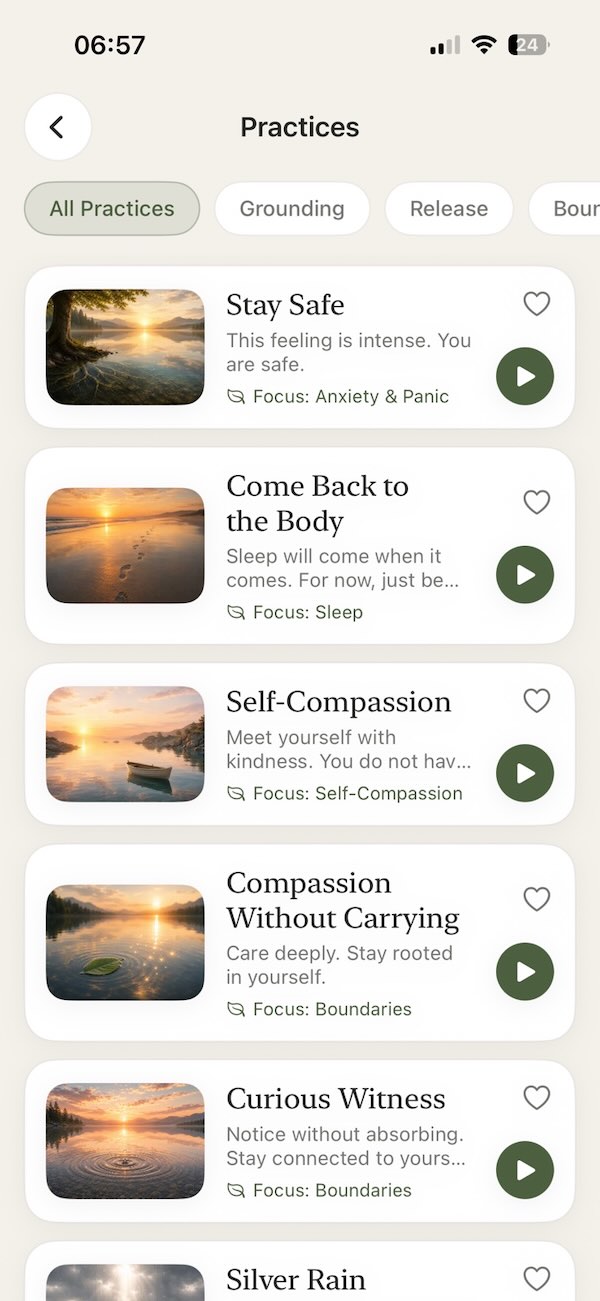
Ready for more support?
Continue your journey in Aira
Access the full library of guided practices, tools, and resources anytime, anywhere.
- 10+Guided Practices
- AnxietyRelief Tools
- SleepSupport
- TrackYour Progress
- OfflineAccess
Available on iPhone and iPad