Why Am I Anxious at Night? Understanding Nighttime Anxiety
Why anxiety so often feels worse at night, what keeps the nervous system activated after dark, and the broad shape of what helps calm and sleep return.

If you've ever found yourself lying awake wondering "why am I anxious at night?" — you're not alone. Many people experience anxiety that feels manageable during the day but becomes much stronger in the evening. The house gets quiet, the distractions disappear, the responsibilities of the day are finished, and suddenly anxiety that seemed distant during the afternoon becomes impossible to ignore.
For some people, nighttime anxiety shows up as racing thoughts. For others, it's restlessness, tension, or an uncomfortable sense that something is wrong. This is the overview of why that happens — why the nervous system so often becomes more noticeable after dark, and what that means.
Why anxiety often feels worse at night
During the day, your attention is usually focused outward — work, conversations, errands, messages, decisions. The brain has plenty to process. But when evening arrives, much of that external stimulation disappears, and for the first time all day there's space to notice what's been happening internally. This is one reason anxiety at night can feel so intense: the anxiety may not actually be stronger — you may simply be noticing it more clearly.
When the day goes quiet
Many people spend an entire day functioning normally, then get into bed, turn off the lights, put the phone down — and suddenly the mind becomes active. The nervous system doesn't always relax the moment your schedule ends. In fact, for many people the body only begins processing the day's stress once everything else stops. That's why anxiety after dark can feel so confusing: nothing new has happened, yet the feeling is louder.
Common nighttime anxiety symptoms
Nighttime anxiety looks different for different people. It can include racing thoughts, muscle tension, restlessness, difficulty falling asleep, chest tightness, worry about the future, a heightened awareness of body sensations, a feeling of being on edge, and a sense of dread without a clear cause. Some people feel anxious only at night; others notice that existing anxiety is amplified in the evening. Both are common.
Why the mind starts replaying everything
Anxiety feeds on uncertainty, and nighttime is fertile ground for it. The mind starts reviewing conversations, mistakes, unfinished tasks, future plans, and worries — replaying the past or rehearsing problems that haven't happened. The anxious brain is trying to create safety by thinking, but thinking rarely produces the certainty it's looking for, so one thought becomes another and sleep drifts further away.
Tired but wired: the nervous system in the evening
Your nervous system works hard all day — deadlines, noise, decisions, interactions, responsibilities. Even good experiences cost energy. By evening, many people are physically exhausted but still neurologically activated. That's the strange combination so many describe: you feel tired, but you can't relax; you want sleep, but your mind stays alert. The body is ready to rest; the nervous system simply hasn't caught up yet.
Why it feels so personal after dark
At night there are fewer distractions between you and your inner world. Thoughts feel louder, emotions feel stronger, sensations feel sharper. Many people read this as proof that something is wrong — but usually it just means there's more awareness. The anxiety that surfaces after sunset was often there all day; the quiet simply made it easier to hear.
What helps, in broad strokes
There's no single trick, but most of what helps falls into two directions. The first is preventive: a calming wind-down in the hour before bed, so the nervous system has time to shift gears. The second is in-the-moment: a few simple tools for when you're already lying awake. Both rest on the same principles — reduce stimulation as the evening winds down, bring your attention back to the body and the present, and let thoughts be thoughts without trying to force sleep. Each of those directions has its own detailed guide; this overview is the map they fit into.
The fuller picture
When the unease swells after dark, it lands as a verdict about you: if I feel this anxious at night, something must really be wrong with me. It feels true because the feeling is sharper than it was all day, which seems like proof that it's getting worse.
But the timing tells a different story. All day your attention is pulled outward — work, people, tasks, noise — and that stream of distraction sits between you and your inner world. At night it falls away, and for the first time there's nothing covering what your nervous system has been carrying since morning. So the anxiety usually isn't growing; you're simply hearing it without the daytime noise on top. That's not new damage — it's the same background load, finally audible. And a system that gets loud in the quiet isn't broken; it's a tired one asking to be heard. The truer question isn't "what's wrong with me?" but "what has my system been carrying that it's only now got the space to feel?" You're not malfunctioning after dark. You're just finally still enough to notice.
Final thoughts
If you experience anxiety at night, you're not alone, and you're not failing. Many nervous systems become more sensitive when the world goes quiet. It doesn't mean something is wrong with you, and it doesn't mean you'll always feel this way. Anxiety at night is often simply a sign that your system has been carrying more than it can comfortably process. The aim isn't to force calm — it's to create enough safety that calm can return on its own. One breath. One moment. One gentle evening at a time.
Try a gentle practice
When anxiety shows up at night, the mind starts searching for answers, explanations, certainty. Sometimes the most helpful thing isn't solving the feeling — it's noticing it with gentle awareness. Observe is a calming practice for nighttime anxiety, overthinking, and restless thoughts, designed to help you step back from what your mind is doing and rest in the simple act of observing.

Try the practice
Observe
Let's step back and see more clearly
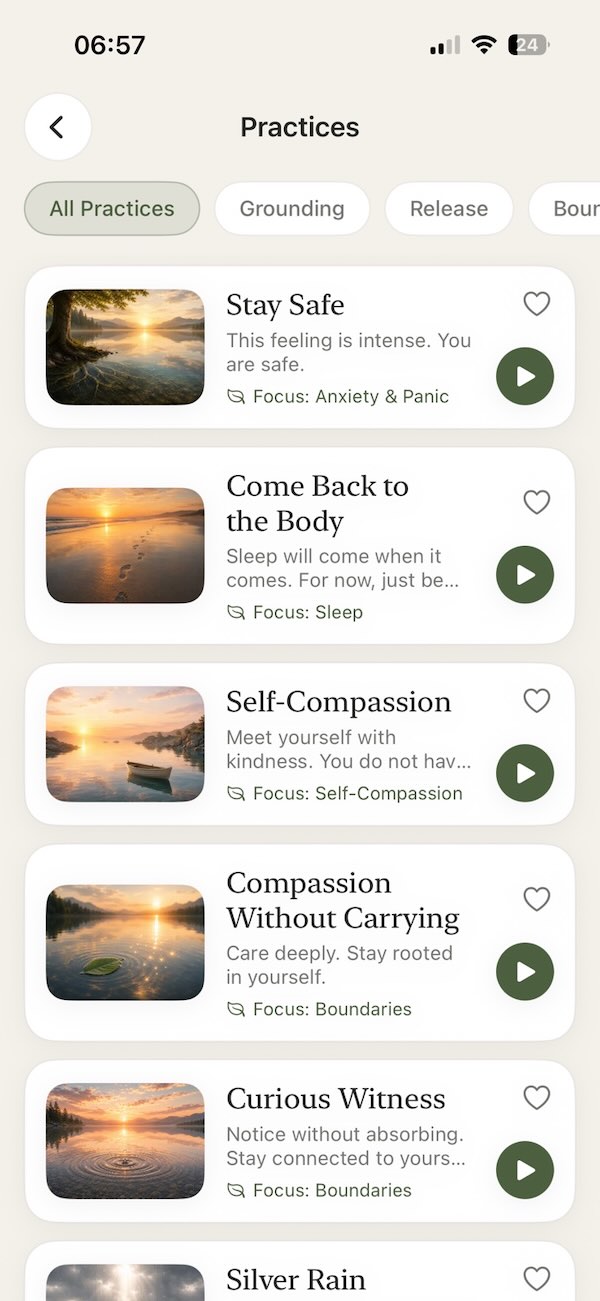
Ready for more support?
Continue your journey in Aira
Access the full library of guided practices, tools, and resources anytime, anywhere.
- 10+Guided Practices
- AnxietyRelief Tools
- SleepSupport
- TrackYour Progress
- OfflineAccess
Available on iPhone and iPad