When Life Feels Too Much: Anxiety, Overwhelm, and Emotional Exhaustion
When anxiety feels less like fear and more like "I can't take one more thing." A look at overwhelm, overstimulation, and emotional exhaustion — and gentle ways to lower the load.

Sometimes anxiety doesn't feel like fear, panic, or even worry. Sometimes it feels like one simple sentence: "I can't take on one more thing." Too many decisions, too many responsibilities, too many messages, too many people needing something from you. You wake up already tired, simple tasks take unusual effort, and even things you normally enjoy start to feel heavy.
If that sounds familiar, you may be experiencing overwhelm — the particular kind of anxiety that comes not from a single fear but from carrying more at once than your system can comfortably hold. (When anxiety flares specifically around stressful events, or settles in as a constant daily presence, those are related but distinct experiences with their own articles; this one is about being over capacity right now.)
What overwhelm actually is
The nervous system has limits. For short bursts it can handle extraordinary demands, but it was never built to run at full output without recovery. Overwhelm is what happens when the demands arriving at once exceed the resources you have to meet them. It isn't a character flaw or a failure of willpower — it's a capacity problem. The load is simply larger than the system can process in the moment.
Why everything feels urgent at once
One hallmark of overwhelm is that everything feels equally important and equally pressing. That's not really a thinking error so much as a feature of an overloaded brain: when too much arrives together, the mind loses its ability to rank and prioritize, so every task glows with the same urgency. The result is a kind of paralysis — so much feels essential that it becomes hard to start anything at all.
When you can't take one more thing
Many people notice that overwhelm announces itself through a final, often tiny, straw: a small request or minor inconvenience that triggers a reaction far bigger than it seems to warrant. That response isn't really about the small thing — it's the sign of a system already at the edge of its capacity, with no room left for one more demand. Common signs include difficulty concentrating, forgetfulness, irritability, decision fatigue, restlessness, and a strong urge to withdraw from everything.
Overstimulation and sensory overload
Overwhelm isn't always about responsibilities — sometimes it's about sheer input. Notifications, screens, news, messages, noise, and constant information all ask for attention, and even positive stimulation adds up when the nervous system gets no chance to recover. Many people live in a state of low-grade overstimulation without naming it, feeling restless, sensitive to noise, mentally frayed, and unable to settle. When this is the pattern, the nervous system isn't asking for more solutions. It's asking for less input.
Emotional exhaustion
When the load stays high long enough, overwhelm shades into emotional exhaustion — running on empty. It can look like numbness, loss of motivation, reduced enjoyment, feeling drained by ordinary tasks, and being slow to recover after stress. The instinct is usually to push harder, but exhaustion rarely responds to more effort; it responds to recovery. This is the exhausting paradox many people describe: too depleted to keep going, yet too activated to truly rest.
When overwhelm becomes burnout
When overwhelm and emotional exhaustion continue for long enough without recovery, they can tip into burnout, and burnout and anxiety often arrive together, each feeding the other. Common burnout symptoms include deep fatigue that rest doesn't seem to fix, cynicism or detachment, a loss of motivation, difficulty concentrating, and a sense of running on empty — alongside the signs of emotional exhaustion already described. Recovering from burnout usually isn't about pushing harder or organising your time more cleverly; it means genuinely reducing the load and allowing real recovery — protected rest, lighter demands, support from others, and time. Burnout tends to build slowly, and it tends to ease slowly too. If it's persistent or starting to affect your health, it's worth speaking with a doctor or therapist.
What helps when you're overwhelmed
When you're over capacity, simple beats clever. The aim is to lower the load, not to manage it more efficiently.
Reduce one source of input
Turn off one notification, delay one task, close one tab, create one small pocket of quiet. You don't have to fix everything — just remove one thing from the pile.
Do one thing at a time
An overwhelmed mind tries to solve everything simultaneously. The nervous system responds far better to a single, manageable step than to the whole list at once.
Come back to the body
Notice your feet, your breathing, the surface beneath you. Overwhelm lives in the sense of all of it; the body lives in the much smaller present, where only this moment is actually happening.
Rest before you hit empty
Rest isn't a reward you earn by finishing everything — it's a biological need. Waiting until total collapse only makes recovery longer. A little rest, taken early, protects far more than it costs.
The fuller picture
When life tips into too much, the mind reaches a quick, harsh verdict: I'm not coping well enough — I should be able to handle all of this, and something's wrong with me that I can't. It feels obvious in the moment, because everyone else seems to be managing and you're the one fraying.
But that reading has it backwards. Overwhelm isn't a sign you're coping badly — it's a sign you've been coping, hard, for a long time, quite possibly longer than any nervous system can comfortably sustain. It's a capacity problem, not a character flaw: the load outgrew the resources, exactly as it would for anyone. You don't need to become someone who can carry unlimited weight. You need to notice when the weight has simply grown too heavy — and answer that by setting some of it down, not by criticising yourself for buckling under it.
Final thoughts
If you're overwhelmed, overstimulated, and emotionally exhausted, it likely doesn't mean anything is wrong with you. It usually means your nervous system has been asking, for a while now, for something it hasn't received: space, quiet, recovery, support. You don't have to carry all of it today, and you don't have to solve all of it today. For this moment, something smaller is enough — one breath, one task, one thing removed from the pile. From there, the next step can wait.
Try a gentle practice
When everything feels like too much, the mind races, the body tightens, and it's hard to know where to begin. For a moment, you can let go of everything that comes next and return to where you are right now. Ground is a gentle practice for exactly those moments — a way to find your footing, steady an overloaded system, and reconnect with the solid simplicity of the present.

Try the practice
Ground
Let's come back to what's real
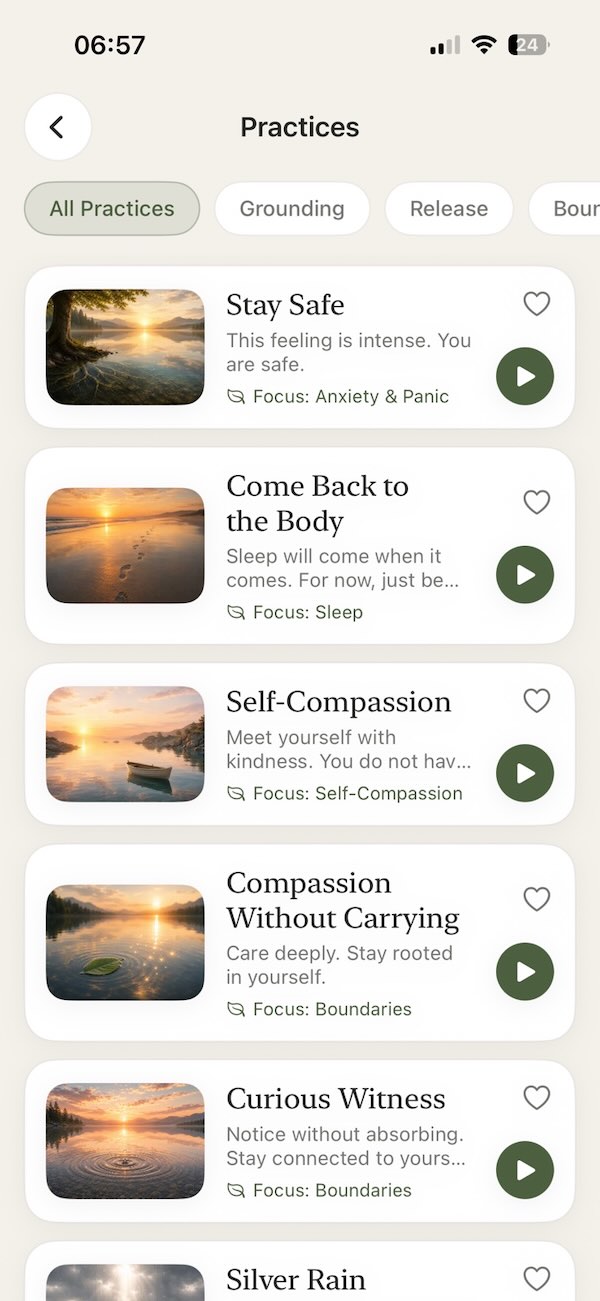
Ready for more support?
Continue your journey in Aira
Access the full library of guided practices, tools, and resources anytime, anywhere.
- 10+Guided Practices
- AnxietyRelief Tools
- SleepSupport
- TrackYour Progress
- OfflineAccess
Available on iPhone and iPad