Why Do I Overthink at Night?
Why your mind speeds up the moment you lie down, how overthinking feeds insomnia, and how to loosen the struggle with thoughts so rest can arrive.
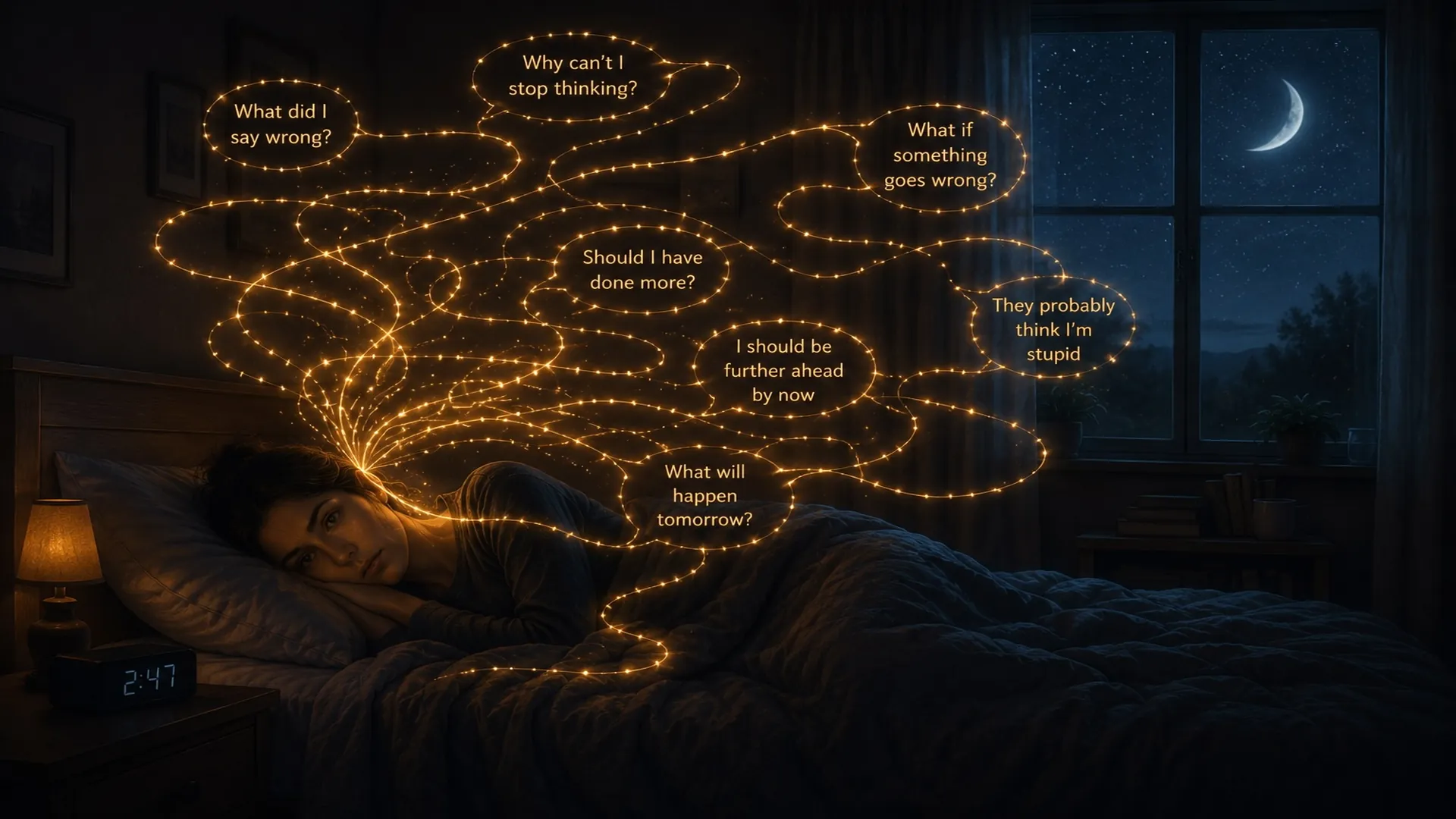
Have you ever noticed that your mind seems quiet during the day but suddenly becomes incredibly active the moment you get into bed? The lights go out. The distractions disappear. And suddenly your brain wants to revisit every conversation, solve every problem, and prepare for every possible future.
You tell yourself "I should be sleeping." Instead, you find yourself thinking. And thinking. And thinking.
If this happens regularly, you're not alone. Nighttime overthinking is one of the most common experiences among people who struggle with anxiety, stress, perfectionism, and an overactive mind.
Why does overthinking get worse at night?
Many people assume something is wrong with them because they overthink at night. In reality, several factors make nighttime a perfect environment for overthinking.
There are fewer distractions
During the day, your attention is pulled in many directions — work, conversations, tasks, messages, responsibilities. At night, those distractions disappear, and the mind suddenly has room to notice everything it has been carrying.
The brain starts processing unfinished things
The mind naturally wants closure. When the day slows down, unresolved concerns often rise to the surface — something you forgot to do, a conversation that bothered you, a decision you need to make, tomorrow's responsibilities, future uncertainties. The brain tries to tie up loose ends before sleep, and sometimes it gets stuck trying.
Anxiety becomes more noticeable
Anxiety often feels louder at night — not necessarily because anxiety has increased, but because there's less competition for your attention. The worries that were in the background during the day suddenly move into the spotlight.
Why won't my brain shut off?
Many people ask "why can't I stop thinking before bed?" The answer is often surprising: the mind isn't malfunctioning — it's doing exactly what minds do. It thinks. The problem isn't that thoughts appear; it's that we often become entangled with them. One thought leads to another, then another, then another. Soon the mind is running dozens of mental simulations while the body is trying to sleep.
Racing thoughts before sleep
Nighttime overthinking often feels like racing thoughts. You may jump between tomorrow's plans, past mistakes, future worries, relationship concerns, work problems, and random memories. The speed of the thoughts can make it feel impossible to relax — and the more you try to stop thinking, the more attention the thoughts receive.
Overthinking and insomnia
One of the biggest frustrations is that overthinking can make sleep feel impossible. The cycle often looks like this: you start thinking, you notice you're still awake, you become frustrated, you start worrying about sleep, the frustration creates more activation, the mind becomes even busier, and sleep feels further away. At that point, the struggle is often no longer about sleep itself — it becomes a struggle with thinking.
Why nighttime thoughts feel so important
Have you ever noticed how convincing nighttime thoughts can feel? A problem that seems manageable during the day can feel enormous at midnight. This happens because fatigue affects perspective. The nervous system is more vulnerable when tired, and the brain tends to focus on potential threats, so worries often appear larger and more urgent than they truly are.
How to ease overthinking at night
The goal isn't to force your mind to become silent. It's to change your relationship with what the mind is doing.
Stop fighting the thoughts
The harder you try to suppress thoughts, the more attention they receive. Thoughts aren't the problem; the struggle with thoughts often becomes the problem.
Notice instead of analyze
Rather than diving into every thought, practice noticing that thinking is happening. A thought doesn't automatically require action — a thought is simply a thought.
Return to direct experience
Bring attention back to the feeling of the mattress, your breathing, the sounds around you, the weight of your body. This helps reconnect with the present moment.
Allow the mind to think
Paradoxically, many people experience less overthinking when they stop demanding that the mind stop thinking. Thoughts lose power when they're allowed to come and go naturally.
The fuller picture
Lying in the dark, the thoughts feel urgent enough to obey: if these worries feel this huge at midnight, they must be real — I have to think them through now. It feels true because the dread is vivid and the night is silent, with nothing to argue against it.
But midnight is one of the worst vantage points there is. You're tired, and fatigue narrows perspective — the nervous system is more vulnerable when depleted, and it tilts toward threat, so an ordinary concern swells to twice its size. The problem didn't grow; the lens did. That's why the thought that felt catastrophic at 1 a.m. so often looks ordinary by morning: nothing was solved overnight, the light just came back and the distractions returned. And nothing on that list actually needs solving in the dark — the mind only feels it does because the quiet finally let the worries get loud. You don't have to trust the midnight version of your life, and you don't have to think your way to the bottom of it tonight. Let the hour pass. Look again when the lens widens.
The bottom line
Nighttime overthinking doesn't mean there's something wrong with you. It often means your mind is doing what it has always done: trying to solve, prepare, protect, and understand. The challenge is that the mind rarely sleeps its way into rest — sleep tends to arrive when the struggle with thinking softens. You don't need to solve every problem tonight, answer every question, or follow every thought. Sometimes the most helpful thing you can do is simply notice that thinking is happening, and let it be.
Try a gentle practice
When your mind keeps moving from one thought to the next, it can feel impossible to find rest — the more you try to stop thinking, the more active the mind often becomes. Observe is a gentle practice for nighttime overthinking, racing thoughts, and a mind that won't slow down, designed to help you step back from the stream of thoughts, notice them with curiosity, and discover that you don't need to follow every thought that appears.

Try the practice
Observe
Let's step back and see more clearly

Ready for more support?
Continue your journey in Aira
Access the full library of guided practices, tools, and resources anytime, anywhere.
- 10+Guided Practices
- AnxietyRelief Tools
- SleepSupport
- TrackYour Progress
- OfflineAccess
Available on iPhone and iPad