Why Highly Sensitive People Burn Out Faster
Why highly sensitive people are more prone to burnout, how a sensitive nervous system depletes faster, and how HSPs can protect their energy.

If you're highly sensitive, you may have noticed you reach burnout faster than the people around you — worn out by environments and demands others seem to shrug off. This isn't fragility or a lack of resilience. A highly sensitive person processes more deeply and absorbs more, which means the same world simply costs them more energy. Understanding why helps you protect yourself rather than push past limits that are real.
This is a guide to why highly sensitive people burn out faster, and what helps.
What it means to be highly sensitive
A highly sensitive person (HSP) has a nervous system that processes everything — sensory input, emotions, social cues, subtleties — more deeply than most. It's a normal trait found in a sizeable minority of people, with real gifts: depth, empathy, perceptiveness, creativity. But the same depth of processing that makes HSPs perceptive also makes them tire faster, because more is being taken in and worked through at every moment. (There's a fuller guide to being a highly sensitive person.)
Why sensitivity leads to faster burnout
For an HSP, the same day delivers more to process — more sensory input registered, more emotional undercurrents felt, more detail absorbed. All that processing uses energy, so a sensitive nervous system depletes faster than a less sensitive one in the same conditions. Where someone else can sit in a loud, busy, emotionally charged environment and feel fine, an HSP may leave it drained. It's not that they're coping worse; it's that they're doing far more internal work to be in the same place.
Absorbing others' emotions
HSPs often feel other people's emotions strongly, sometimes as if they were their own. In demanding or emotionally heavy environments — caregiving, intense workplaces, conflict — this means absorbing not just their own stress but everyone else's. Without strong boundaries around it, the emotional load piles up quickly, which is why HSPs are especially prone to the kind of depletion that leads to empath burnout. (Empath burnout has its own guide.)
Overstimulation and the need to recover
Because they take in so much, HSPs reach overstimulation faster — the frazzled, overloaded 'too much' state — and need more downtime to recover from it. In a culture that prizes constant activity and rarely values rest, HSPs are at a structural disadvantage: they need more recovery than average, in a world that offers less. Pushing through without that recovery is a direct route to burnout.
How HSPs can protect themselves
The key for a highly sensitive person isn't to become less sensitive — it's to honour the nervous system you have. Protect your sensory environment, reducing overstimulation where you can. Build in more recovery time than you think you 'should' need, without guilt. Set boundaries around how much you take on and how much of others' emotion you absorb. And treat your lower threshold for 'too much' as real information rather than a flaw to override. Working with your sensitivity, rather than against it, is what keeps it a gift instead of a fast track to burnout.
The fuller picture
Watching others shrug off what flattens you tends to produce a harsh verdict: if I burn out faster than everyone around me, I must be weak — too sensitive, less resilient, defective somehow. It feels true because the comparison looks so direct: same room, same day, same demands — and you're the one who leaves drained while they seem fine.
But the comparison isn't measuring what it seems to. You and they didn't have the same day. A highly sensitive nervous system registers more — more sensory input, more emotional undercurrent, more detail — and processes all of it more deeply, so the identical environment costs you far more energy. Burning out faster isn't coping worse; it's doing far more internal work to be in the same place. "They're fine and I'm not" isn't evidence you're weaker — it's evidence you're carrying a heavier internal load they never had to. And the depth that tires you isn't a flaw bolted onto you: it's the same trait that makes you perceptive, empathic, attuned — the gift and the cost are one thing, not two. So the faster depletion isn't a defect to override by pushing harder. It's accurate information about the system you have — one that needs more quiet and more recovery than average, not because you're failing, but because that's the correct maintenance for a nervous system that feels everything more.
Final thoughts
If you burn out faster as a highly sensitive person, it isn't because you're weak — it's because you're doing more internal processing than the people around you, in a world that rarely accounts for it. You're allowed to need more rest, more quiet, and firmer limits than others, and honouring that isn't self-indulgence; it's how a sensitive person stays well. Your sensitivity is real, and so are its needs. One protected quiet, one honoured limit at a time.
Try a gentle practice
When a sensitive nervous system tips toward overload, grounding helps it settle before depletion sets in. Ground is a gentle practice for exactly that — a way to come back to your body and the present when everything feels like too much, steady an overstimulated system, and give a sensitive nervous system the reset it needs.

Try the practice
Ground
Let's come back to what's real
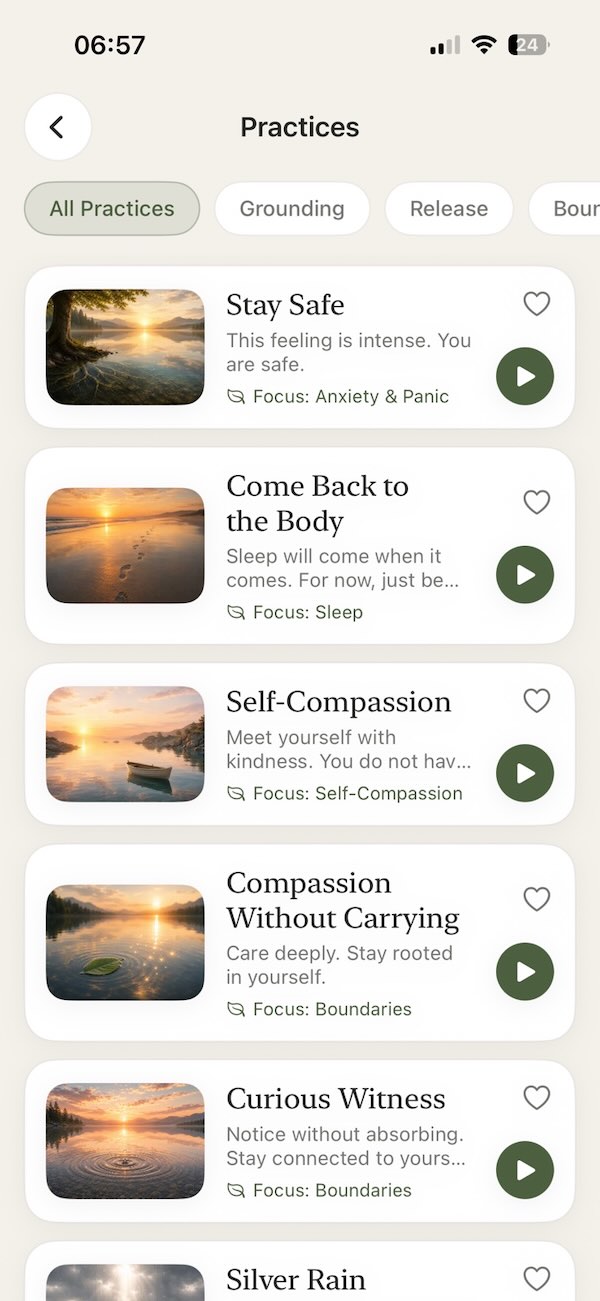
Ready for more support?
Continue your journey in Aira
Access the full library of guided practices, tools, and resources anytime, anywhere.
- 10+Guided Practices
- AnxietyRelief Tools
- SleepSupport
- TrackYour Progress
- OfflineAccess
Available on iPhone and iPad