Why Reassurance Never Fully Works for Anxiety
Why reassurance only soothes anxiety for a moment, how the reassurance-seeking cycle keeps fear alive, and how to build a sense of safety from within.

When anxiety shows up, many people look for reassurance. They ask a friend "do you think everything will be okay?" They search online "is this symptom normal?" They replay conversations and wonder "do you think I said the wrong thing?"
For a moment, reassurance helps. The anxiety softens, the fear settles, relief appears. But then something happens: the doubt returns, and the mind starts searching again.
If this sounds familiar, you're not alone. Reassurance seeking is one of the most common habits in anxiety. The problem is that while reassurance feels helpful in the short term, it often keeps anxiety alive in the long term.
What is reassurance seeking?
Reassurance seeking is the attempt to reduce anxiety by looking for certainty, confirmation, or guarantees. People may seek it by asking friends for advice repeatedly, looking up symptoms online, replaying conversations, checking messages multiple times, seeking validation from others, asking the same question in different ways, or looking for certainty before making decisions. At its core, reassurance seeking is usually an attempt to answer one question: "am I safe?"
Why do I need reassurance?
Many people assume reassurance seeking means they're weak, needy, or dependent. In reality, it usually means the nervous system is feeling uncertain. Anxiety dislikes uncertainty — the brain wants answers, guarantees, proof that nothing bad will happen. Reassurance temporarily provides that feeling, but the relief rarely lasts.
The anxiety-reassurance cycle
The cycle often looks like this. First, anxiety appears — a worry enters the mind: "what if I made a mistake?" Then reassurance is sought — you ask someone "do you think it's okay?" Then relief arrives — the answer helps, for a little while. Then doubt returns — the mind asks "but what if they're wrong? maybe I didn't explain it properly. should I ask someone else?" And the cycle begins again.
Why reassurance never feels like enough
Most people think they need better reassurance. In reality, they usually need less dependence on it. The problem isn't the quality of the answer — it's that anxiety demands certainty, and certainty is rarely available. No matter how many times someone reassures you, the future remains uncertain. The mind notices this, and the doubt returns.
Reassurance seeking in relationships
Relationship anxiety often creates reassurance-seeking behaviors: "do you still love me? are you upset with me? is everything okay between us? did I do something wrong?" These questions usually come from a place of fear rather than curiosity. The goal isn't information — it's relief. Unfortunately, relief tends to be temporary, and the fear often returns.
Reassurance seeking and OCD
People with OCD frequently experience intense reassurance-seeking urges. The brain becomes convinced that certainty is necessary, and the person feels compelled to ask, check, or confirm. The reassurance provides short-term relief, the obsession returns, and the cycle strengthens.
Why validation doesn't solve anxiety
Validation, connection, and support are healthy. The problem occurs when reassurance becomes the primary way we regulate fear. At that point, the brain begins to learn "I cannot feel safe until someone else tells me I'm safe." Over time, confidence in your own ability to tolerate uncertainty starts to weaken.
What anxiety is really looking for
Most reassurance seeking isn't actually about answers — it's about safety. The mind believes "if I can know for sure, I can relax." But safety and certainty aren't the same thing. You can feel safe even when you don't know everything. This is one of the most important lessons in anxiety recovery.
How to reduce reassurance seeking
Notice the urge
The moment you want to ask, check, search, or confirm, pause. Simply notice: "I'm looking for reassurance." Awareness creates choice.
Ask what you're hoping to feel
Instead of asking "what answer do I need?", try "what feeling am I looking for?" Most people discover they're looking for safety, not information.
Practice tolerating uncertainty
You don't need certainty to move forward. You only need enough willingness to take the next step.
Build internal safety
The goal isn't to never ask for support. It's to trust that your sense of safety can come from within as well.
The fuller picture
Every search, every "are you sure?" rests on one hope: if I can just get the right answer, enough reassurance, I'll finally feel safe. It feels true because reassurance does bring relief — for a minute or two — so the next answer always seems like the one that will finally land.
But notice what you're actually reaching for. It isn't information; it's a feeling of safety. And that's why no answer holds: the mind isn't short on answers, it's short on tolerance for not knowing, so the doubt regrows the moment the relief fades. Worse, each time safety arrives from outside you — someone else's "it's fine" — the brain quietly learns I can't feel okay until someone tells me I'm okay, and your own capacity to sit with uncertainty thins. So the relief you keep buying is quietly deepening the need. The way out isn't a better answer; it's noticing that safety and certainty were never the same thing. You can feel safe without knowing for sure — and that kind of safety, unlike reassurance, is one no one has to keep handing back to you.
The bottom line
Reassurance feels helpful because it temporarily quiets anxiety. But anxiety is rarely satisfied for long — soon another doubt appears, another question, another search for certainty. Lasting relief often begins when we stop trying to eliminate uncertainty and start learning how to feel safe alongside it. You don't need every answer. You don't need every guarantee. You don't need certainty before you can live your life.
Try a gentle practice
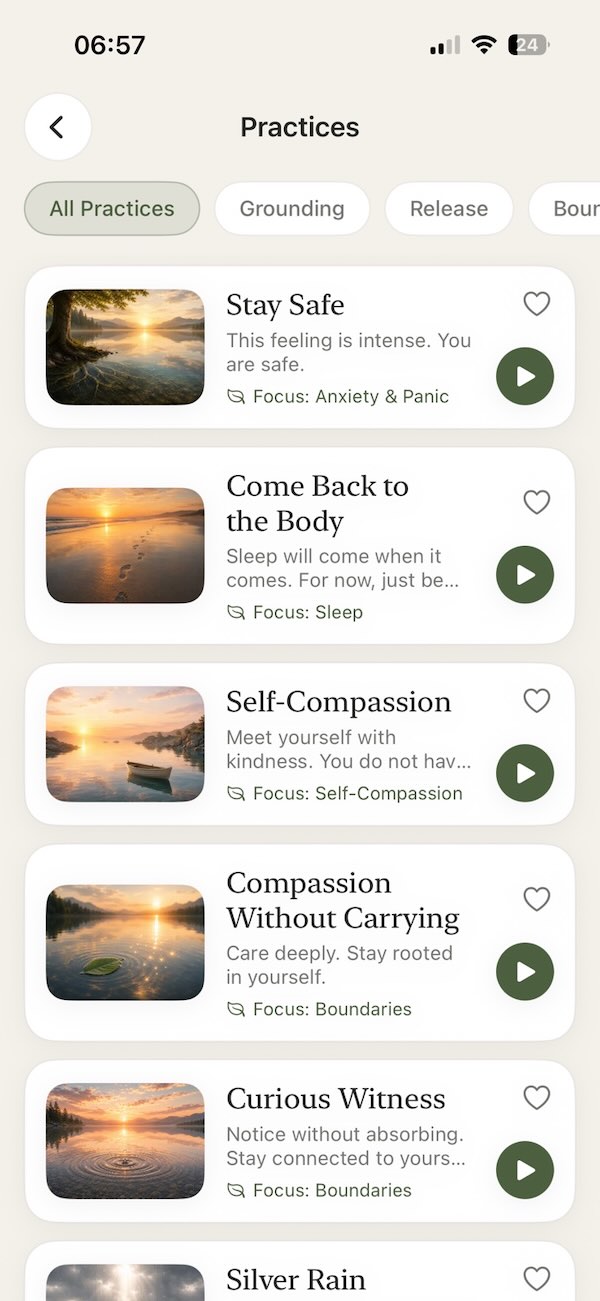
When anxiety is asking for reassurance, the urge to check, ask, or confirm can feel impossible to resist. Curious Witness is a gentle practice for reassurance-seeking and uncertainty — a way to notice the urge with curiosity and let it rise and pass without acting on it, so your sense of safety can begin to come from within rather than from the next answer.

Try the practice
Curious Witness
Notice without needing to change.
Ready for more support?
Continue your journey in Aira
Access the full library of guided practices, tools, and resources anytime, anywhere.
- 10+Guided Practices
- AnxietyRelief Tools
- SleepSupport
- TrackYour Progress
- OfflineAccess
Available on iPhone and iPad