Why Your Body Reacts to Stress Before You Even Notice
Why your body reacts to stress before your mind catches up, why you can feel tense for no clear reason, and how to use that early physical signal instead of fearing it.

You feel it before you understand it. Your shoulders climb, your stomach tightens, your breath goes shallow — and only a beat later, if at all, does your mind catch up with why. Sometimes it never does, and you're left tense for no reason you can name. This isn't a glitch. Your body is built to react to stress before your conscious mind has finished processing it, and once you understand that, a whole category of "anxiety from nowhere" starts to make sense.
This is a guide to why your body reacts first: how it happens, why you can feel tense for no clear reason, and how to use that early physical signal instead of being confused by it.
Why the body reacts first
Your nervous system is designed for speed. When something registers as a possible threat, the fast, protective part of your brain triggers a stress response — heart rate up, muscles braced, senses sharpened — long before the slower, thinking part of your brain has weighed up whether there's really anything to worry about. In survival terms this is a feature, not a flaw: it's better to flinch at a stick that might be a snake than to deliberate while the snake bites. The reaction comes first; the explanation, if it comes, comes second.
The catch is that this same system fires for modern, non-physical "threats" too — a critical email, an anticipated conflict, a passing worry. Your body braces as if for danger, even when the trigger is only a thought.
Why you feel tense 'for no reason'
Often the thought that set you off moves too fast to notice. A worry flickers past at the edge of awareness — half a second, barely conscious — and your body responds to it immediately. What you're left with is the physical reaction without the story: tight, wired, uneasy, with no obvious cause. It feels like anxiety from nowhere, but there was a trigger. You just didn't catch it, because your body reacted before your mind could register what it was reacting to.
This gap — between the body's response and your awareness of it — is the source of so much confusing tension. And it's also, as it turns out, exactly where you can intervene.
The body as an early warning system
Here's the reframe that changes everything: if your body reacts before your mind catches up, then your body is a faster alarm than your thoughts. You may not always catch the triggering thought, but you can learn to catch the reaction — the shoulders lifting, the jaw setting, the belly tightening, the breath going high and shallow. Those signals are information. They're your system telling you something just registered as a threat, even if your conscious mind missed it.
Most people treat these sensations as the problem to get rid of. But they're actually a message worth reading. The tension isn't the enemy; it's the smoke that tells you where to look.
How to work with the signal
Once you start treating the body's reaction as an early warning rather than a nuisance, you can work with it in three simple moves. First, notice it — catch the physical signal as early as you can, and treat it as information rather than something to suppress. Second, trace it back — gently ask what happened in the last minute: what did you just think, hear, remember, or anticipate? Often, once you go looking, the fast little trigger you missed comes into view and you can name it. Third, let it settle — once the trigger is named and met, help the leftover tension drain with a slow exhale and a softening of whatever's braced, since the body sometimes keeps holding on after the mind has understood.
With practice, this gets quicker. You start catching the reaction earlier and reading it more easily, so the tension that used to feel like an unsolvable mystery becomes a signal you know how to follow. Writing these moments down in a trigger journal speeds this up enormously, because it trains you to link the body's reaction back to what caused it.
When to seek support
If your body is constantly braced, if the physical symptoms are intense or frightening, or if you can never seem to find or settle what's setting you off, it's worth getting support. A doctor can check that the physical sensations aren't something else that needs attention, and a therapist can help you work with a nervous system that's stuck reacting, especially when the triggers are tied to past experiences. Reaching out is sensible — a body that reacts too much, too often, responds well to help.
Final thoughts
Your body reacting before you notice isn't a sign that something is broken. It's a fast, ancient protective system doing its job — sometimes a little too well. The tension that seems to come from nowhere almost always came from somewhere; you just felt it before you saw it. And that early physical signal, rather than being something to fear, can become one of the most useful tools you have: a message that says look here. Learn to read it, and "anxiety from nowhere" slowly becomes anxiety you can understand. One noticed signal at a time.
Try a gentle practice
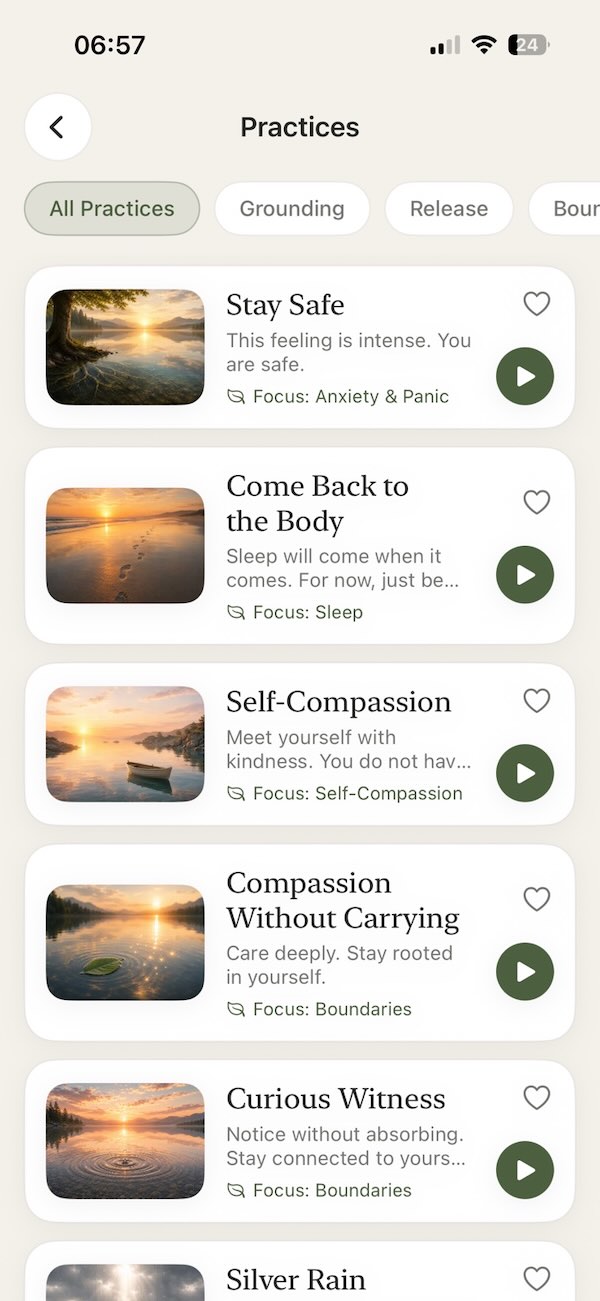
Reading your body's signals starts with being able to feel them clearly, without panic. Come Back to the Body is a gentle practice for exactly that — a way to drop out of your racing head and into simple physical sensation, so the early signals your body sends become something you can notice and trust rather than something that catches you off guard.

Try the practice
Come Back to the Body
Come back from thoughts to sensation.
Ready for more support?
Continue your journey in Aira
Access the full library of guided practices, tools, and resources anytime, anywhere.
- 10+Guided Practices
- AnxietyRelief Tools
- SleepSupport
- TrackYour Progress
- OfflineAccess
Available on iPhone and iPad