Breathing Exercises for Anxiety: How to Use Your Breath to Calm Down
Why your breath can calm anxiety, and the most effective breathing exercises to use — extended exhale, box breathing, 4-7-8, belly breathing, and the physiological sigh.

When anxiety rises, your breathing changes before you even notice it — shallow, quick, and high in the chest. That shift isn't just a side effect; it's part of how anxiety sustains itself. The reassuring part is that breath works in both directions: the same system that speeds up under stress can be gently used to slow it back down. Learning a few simple breathing exercises gives you a tool you carry everywhere, available the moment anxiety starts to build.
This is a guide to breathing techniques for anxiety — why they work, the most effective ones, and how to actually use them. (For breathing during a full panic attack, there's a dedicated guide; here the focus is calming everyday anxiety, tension, and a racing mind.)
Why breathing calms anxiety
Your breath is directly wired to your nervous system, which is what makes it such a useful anchor. When you're anxious, the sympathetic — 'fight or flight' — branch is active, and breathing becomes fast and shallow. Slow, full breathing, especially a long and unhurried exhale, activates the parasympathetic — 'rest and digest' — branch through the vagus nerve, which signals to the body that it's safe to settle. You can't simply decide to feel calm, but you can breathe in a way that nudges your physiology toward calm, and the feeling tends to follow.
The single most important principle is this: the exhale is what calms you. Make your out-breath longer than your in-breath, and you're working with your nervous system rather than against it. Almost every technique below is a variation on that one idea.
Extended exhale breathing
The simplest place to start needs no complicated counting: breathe in gently through your nose for a count of about four, then exhale slowly for a count of about six. Continue for two to five minutes, letting the breath stay soft rather than forced. If counting helps, count; if it doesn't, simply make each out-breath a little longer than each in-breath. This is the most flexible breathing exercise for anxiety because you can do it anywhere, silently, with no one noticing.
Box breathing
Box breathing — sometimes called square breathing — adds a gentle hold and a steady, rhythmic structure that many people find grounding. Inhale for four, hold for four, exhale for four, hold for four, picturing the four sides of a square as you go. Repeat for a few rounds. The even rhythm gives a busy mind something simple to follow, which is part of why it's so widely used for stress and tension. If holding the breath feels uncomfortable or makes you more anxious, shorten the holds or drop them and return to extended-exhale breathing.
4-7-8 breathing
The 4-7-8 technique is a stronger version of the long-exhale principle: inhale quietly through the nose for four, hold for seven, and exhale slowly through the mouth for eight. Because the exhale is long, it can settle the body quickly — but for the same reason, start with just a few rounds, and don't worry about hitting the exact counts. The ratio matters more than the precise numbers; a long, smooth out-breath is the goal, not a breath-holding contest.
Diaphragmatic (belly) breathing
Anxious breathing tends to live high in the chest. Diaphragmatic breathing moves it lower, where it's calmer and more efficient. Rest one hand on your chest and one on your belly. As you breathe in, let the lower hand rise while the upper stays relatively still — you're breathing 'into' your belly rather than your shoulders. Slow belly breathing for a few minutes can ease the tight-chest feeling anxiety often brings, and it's worth practising even when you're calm, so it becomes more automatic when you're not.
The physiological sigh
When you need something fast, the physiological sigh is one of the quickest ways to take the edge off. Take a normal breath in through your nose, then — without exhaling — take a second, shorter sip of air on top to fully inflate the lungs, and let it all out slowly through the mouth in one long exhale. Two or three of these in a row can lower the intensity of anxiety within moments. It's discreet, takes seconds, and works well when there's no time for a longer practice.
How to get the most from breathing exercises
A few things help these techniques work. Practise them when you're calm, not only in crisis — a breath pattern you already know is far easier to reach for when anxiety hits. Keep the breath gentle rather than forcing big, deep breaths, which can actually increase lightheadedness and tension. Expect your mind to wander, and simply return to the count when it does; wandering isn't failure. And give it a minute or two — the nervous system shifts gradually, not instantly.
The fuller picture
Anxiety often comes with a frightening thought about the breath itself: I can't get a full breath — I'm not getting enough air, something must be wrong with me. It's genuinely scary, because the sensation is real — it really can feel like you can't fill your lungs.
Here's the twist most people never get told. In anxiety, that "not enough air" feeling usually comes from breathing too much and too fast, not too little — your body actually has plenty of oxygen. The suffocating feeling is deeply uncomfortable but not dangerous, and it isn't a sign your body is failing; it's a sign your breath sped up. Which is oddly good news: slowing the exhale doesn't only calm you, it eases the very sensation that scared you in the first place.
When breathing alone isn't enough
Breathing is a powerful tool, but it isn't a cure-all, and that's worth saying plainly. On a high-anxiety day, breathing might take the edge off without erasing the feeling — that's still a win. If focusing on your breath ever makes you more anxious, which happens for some people, that's okay; grounding through your senses or gentle movement may suit you better. And if anxiety is persistent and interfering with daily life, breathing exercises work best alongside other support rather than in place of it.
Try a gentle practice
Knowing the techniques helps, but in an anxious moment it's often easier to follow a calm voice than to guide yourself. Breathe is a gentle guided breathing practice for exactly those moments — a way to slow the breath, settle the nervous system, and come back to the present, one exhale at a time.

Try the practice
Breathe
Help me slow down and find calm.
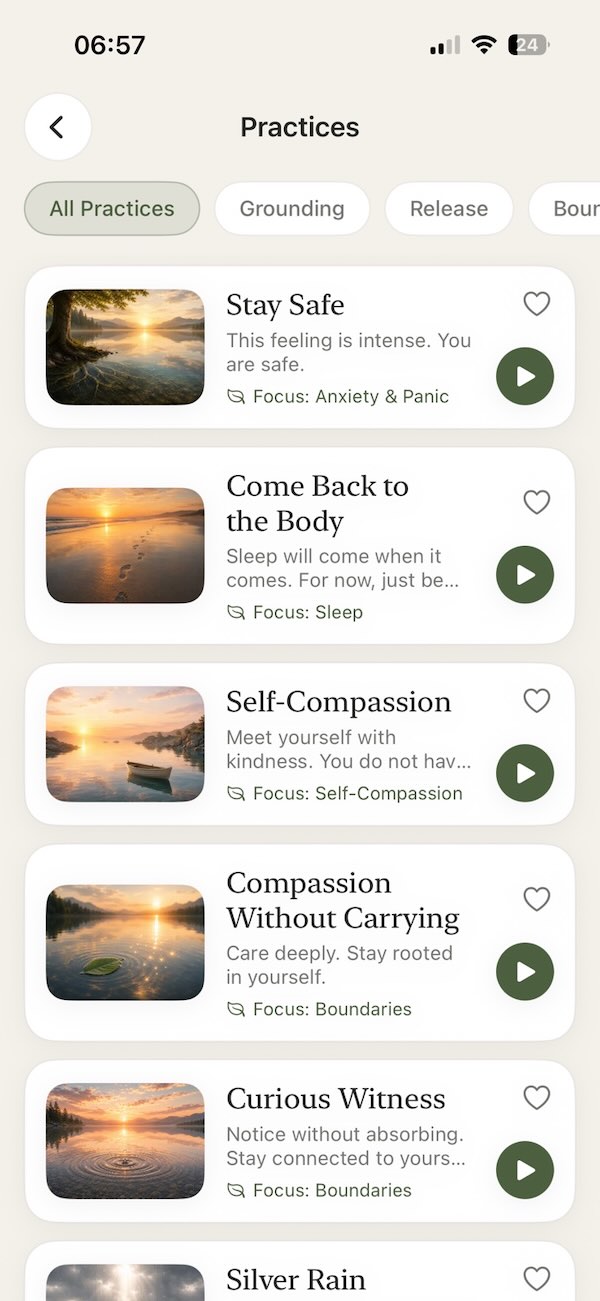
Ready for more support?
Continue your journey in Aira
Access the full library of guided practices, tools, and resources anytime, anywhere.
- 10+Guided Practices
- AnxietyRelief Tools
- SleepSupport
- TrackYour Progress
- OfflineAccess
Available on iPhone and iPad