Feeling Numb After a Loss: Why You Can't Cry
Everyone expected you to fall apart — instead you feel nothing. Here's why grief can leave you numb and unable to cry, and why it doesn't mean you didn't care.

Everyone expected you to fall apart. Instead, you feel… nothing. Flat. Far away. Watching your own life through glass. Maybe you haven't cried, and a small panicked voice has started asking: what's wrong with me? Did I not love them enough?
Nothing is wrong with you. Feeling numb after a loss is one of the most common — and most misunderstood — parts of grief. It is not the absence of love. It's often love's first line of protection.
Why you feel numb instead of devastated
When a loss is too big to absorb all at once, the mind does something quietly merciful: it turns the volume down. Numbness is a circuit breaker. It lets reality reach you in pieces small enough to survive, instead of all at once in a way that would flatten you.
This is why people so often describe the early days of grief as feeling unreal, robotic, or strangely calm. You might handle the funeral with eerie composure and only feel the full weight months later. That delay isn't coldness. It's your system protecting you until you have enough ground under your feet to feel safely.
What grief-numbness feels like
It shows up as:
- Feeling flat, blank, or emotionally "switched off"
- Not being able to cry, even when you want to
- A sense of watching life from behind glass, or going through the motions
- Feeling far away from your own body or from people around you
That last one has a name — it overlaps with feeling detached from yourself and feeling disconnected from reality. These are frightening when you don't have words for them, and far less frightening once you know they're recognized responses to overwhelm, not signs you're broken.
Numbness is a freeze response
There's a physical reason for it too. Faced with something overwhelming, the nervous system doesn't only have fight or flight — it also has freeze, a kind of protective shutdown. Grief-numbness is often freeze: the body going still and quiet because the alternative feels like too much. You can read how this works in the freeze response and shutdown, and the same protective numbing shows up after long stress in emotional numbness after chronic stress.
Knowing this matters, because it reframes the whole experience: you're not failing to grieve. Your body is grieving in the only way it can bear right now.
"Does numbness mean I didn't care?"
This is the fear underneath it all, so let's answer it plainly: no. In fact, numbness often shows up because the loss matters so much — the bigger the love, the more the mind may need to ration the pain. The depth of your numbness can be a measure of the depth of what you lost, not the lack of it.
The feelings almost always return, usually in their own time and often in waves. You don't have to force them. Trying to make yourself cry on schedule only adds pressure. Grief will thaw when you're ready, not when you order it to.
A gentler way to be with the numbness
Instead of fighting the blankness or judging yourself for it, try treating it as information: my system is protecting me, and it will let me feel more when I can hold more. That's not avoidance. That's trust.
If you'd like to gently invite feeling back without forcing it, small, kind contact with your body can help — warmth, slow movement, a hand on your chest. Returning to your body offers soft ways to do this. And when self-judgment creeps in — I should be feeling more by now — meet it the way you'd meet a hurting friend, which is the heart of self-compassion. Numbness, like everything in grief, is part of what's normal.
When to reach for more support
Numbness is a normal phase of grief. But if it lasts a very long time, if you feel permanently cut off from yourself or everyone around you, or if the disconnection frightens you or stops you from living, it's worth talking to a doctor or therapist. Persistent numbness can sometimes signal that grief, or something alongside it, needs more support — and that support exists. Reaching out doesn't mean you're broken. It means you're ready to feel your way back, gently.
Try a gentle practice
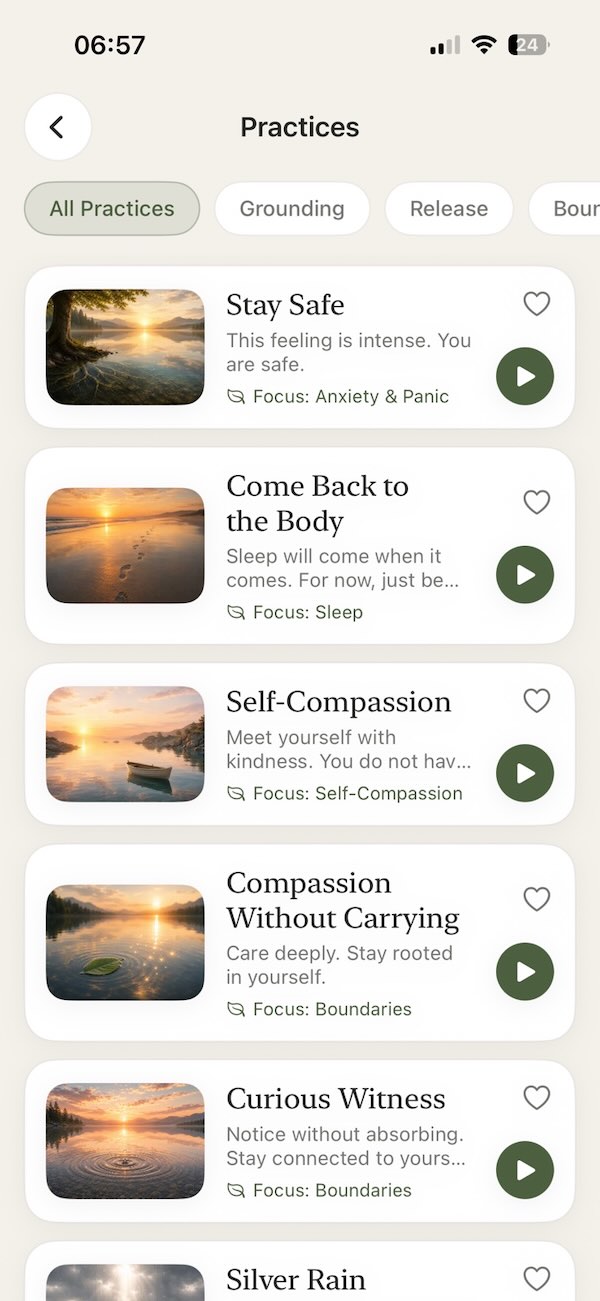
You don't have to force feeling to return — you only have to make it safe to come back. Come Back to the Body is a gentle practice for the numb, faraway moments — a way to reconnect with yourself slowly and kindly, letting sensation return at a pace your system can hold.

Try the practice
Come Back to the Body
Come back from thoughts to sensation.
Ready for more support?
Continue your journey in Aira
Access the full library of guided practices, tools, and resources anytime, anywhere.
- 10+Guided Practices
- AnxietyRelief Tools
- SleepSupport
- TrackYour Progress
- OfflineAccess
Available on iPhone and iPad