Guilt After Loss: "I Should Have Done More"
"I should have done more." If grief has filled your head with guilt and self-blame, you're carrying more than was ever yours to carry. Here's why — and how to set it down.

I should have called more. I should have noticed sooner. I should have been there. I shouldn't feel relieved. I shouldn't be laughing already. If grief has filled your head with sentences that start with I should have, you are carrying one of the heaviest, most common weights of loss — guilt. And almost always, you're carrying more than was ever yours to carry.
Why guilt shows up in grief
Guilt is one of the most universal parts of grieving, and it comes from a strangely tender place. When we lose someone, the mind desperately wants the loss to have been preventable — because if it could have been prevented, then the world still makes sense and we still have some control. So it goes hunting for what you could have done differently.
In other words, much of grief-guilt isn't really evidence that you failed. It's the mind's way of refusing to accept how little control any of us actually had. That's painful, but it's not the same as being guilty.
The many faces of grief-guilt
It wears a lot of disguises:
- "I should have done more." The replaying of calls you didn't make, signs you didn't catch, time you didn't spend.
- Relief guilt. If the loss followed a long illness or a hard relationship, you may feel relief — and then feel monstrous for it. Relief is not betrayal. It's a human response to the end of suffering, yours or theirs.
- Survivor guilt. Why them and not me? A question with no answer, which the mind asks anyway.
- Moving-on guilt. Laughing, enjoying a meal, having a good day — and feeling like joy is a betrayal of the person you lost.
All of these are normal. None of them mean you did something wrong.
The difference between guilt and responsibility
Here's a distinction that can loosen guilt's grip. Real responsibility is specific and proportionate: you did a particular thing, and you can make a particular repair. Grief-guilt is rarely like that. It's vague, enormous, and impossible to satisfy — because no amount of self-punishment can do the one thing you actually want, which is to undo the loss.
That's why guilt in grief can feel bottomless. You're not really trying to fix a mistake. You're trying to bargain with something that can't be bargained with. Recognizing that is the first step toward setting the weight down. We go deeper into this in guilt and self-blame: carrying more than is yours to carry.
You did the best you could with what you knew
This is the sentence guilt does not want you to believe: at the time, with the information, energy, and capacity you actually had, you did the best you could. Hindsight gives you knowledge you simply didn't have in the moment — and then cruelly judges your past self for not having it.
Learning to meet that past self with understanding instead of punishment is its own kind of work, and a healing one. How to forgive yourself walks through it gently. So does softening the inner voice that keeps the case open against you, which we explore in self-compassion.
A gentler way to hold the guilt
Try this shift: instead of what did I do wrong?, ask what is this guilt trying to protect? Often, underneath the guilt is love — the wish that you could have given more time, more care, more presence to someone who mattered. Guilt is frequently grief wearing a harsher mask.
When you can see it that way, you can answer it more kindly. You don't have to win the argument with your guilt. You only have to stop letting it pretend that punishing yourself honors the person you lost. It doesn't. Living gently, carrying their memory with love rather than self-blame — that honors them far more. Guilt, like the rest of grief, also comes and goes in waves; a fresh wave of it doesn't mean you've done something newly wrong.
The fuller picture
Underneath all the I should haves sits one sentence the mind keeps insisting on: I should have done more — the loss was preventable, and it's my fault. It feels true because guilt, strangely, offers a kind of comfort: if it could have been prevented, then the world still makes sense and you still had some control. Blaming yourself can hurt less than accepting how little any of us actually controls.
But notice the shape of this guilt. When you're truly responsible for something, the guilt is specific and it has an exit — a clear act, a repair you can make. This guilt has neither; it's bottomless, and nothing you do ever satisfies it, because the only thing it will accept is the loss undone. You're not fixing a mistake — you're bargaining with something that can't be bargained with. And the should have is built on what you only know now: the mind quietly hands your past self today's information, then blames them for not having acted on it. That past self did the best they could with what they actually had. Setting the guilt down isn't forgetting the person. It's stopping a punishment that was never going to bring them back.
When to reach for more support
Guilt is a normal part of grief, but it can become corrosive — if it hardens into constant self-punishment, convinces you that you don't deserve to heal, or keeps you stuck for a long time, please talk to a grief counselor or therapist. Guilt this heavy is treatable, and you deserve to set down what was never yours to carry. Reaching out isn't letting yourself off the hook — it's letting yourself begin to heal.
Try a gentle practice
Guilt keeps the case open against you; this is a way to gently begin to close it. As You Are is a gentle practice for the moments self-blame feels loud — a way to meet yourself with the same kindness you'd offer someone you love, and set down a little of what was never yours to carry.

Try the practice
As You Are
Let yourself be as you are.
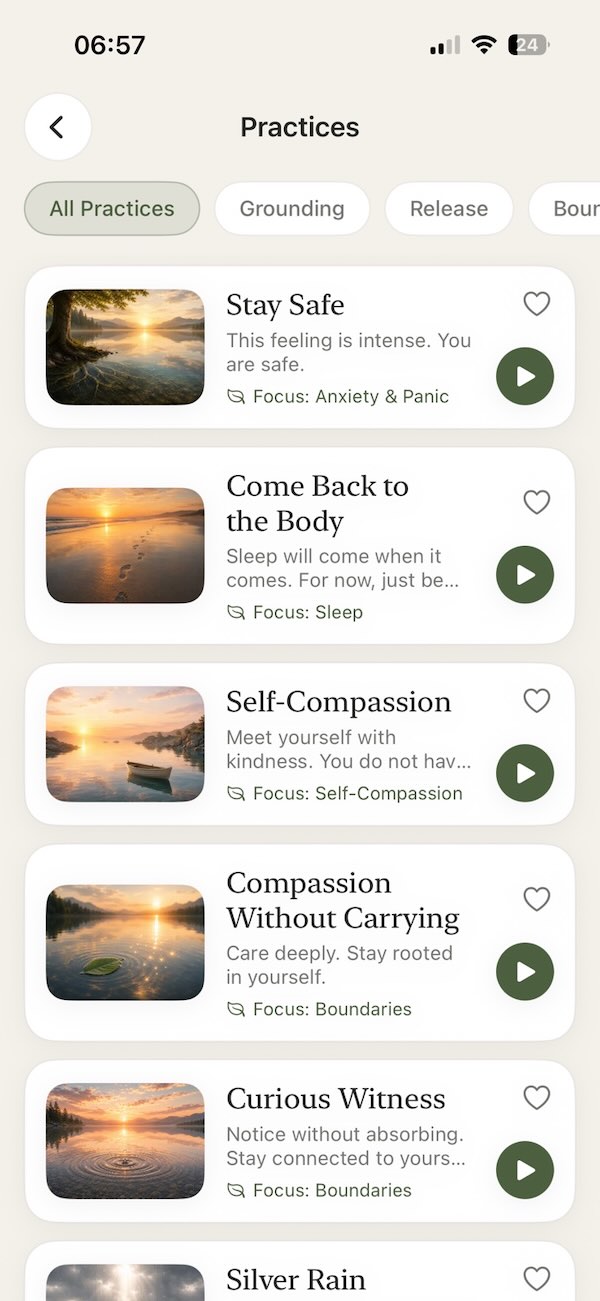
Ready for more support?
Continue your journey in Aira
Access the full library of guided practices, tools, and resources anytime, anywhere.
- 10+Guided Practices
- AnxietyRelief Tools
- SleepSupport
- TrackYour Progress
- OfflineAccess
Available on iPhone and iPad