How to Identify Your Anxiety Triggers: A Simple Trigger Journal
Why anxiety triggers are so hard to spot, how to identify yours with a simple trigger journal, and how to turn what you find into patterns you can actually work with.

Anxiety often feels like it comes from nowhere. One moment you're fine, the next your chest is tight, your thoughts are racing, and you couldn't say why. But anxiety almost always has a trigger — something that set it off — even when that something flew by too fast to notice. Learning to identify your triggers is one of the most useful skills there is, because a trigger you can see is a trigger you can work with. The simplest way to find yours is to keep a trigger journal.
This is a guide to identifying your anxiety triggers: what a trigger is, why they're so hard to catch, and how a simple daily journal makes the hidden ones visible.
What is an anxiety trigger?
A trigger is anything that sets off your anxiety — a situation, a thought, a memory, a sensation, a person, even a time of day. Some triggers are obvious: a looming deadline, a difficult conversation, a phone call you've been dreading. Others are quieter and harder to name: a passing worry, an old association, a background sense of not being safe. What they have in common is that they tip your nervous system from calm into activation. The trigger is the match; the anxiety is the flame.
Importantly, a trigger isn't a weakness or an overreaction. It's simply the thing your system has learned to treat as a threat. Once you can name it, you can begin to change how you respond to it.
Why triggers are so hard to spot
The reason anxiety so often feels causeless is that the triggering thought frequently moves faster than your awareness. A worry flickers through, half-conscious, and your body reacts to it before you've consciously registered the thought at all. You're left with the feeling — the tension, the dread — but not the cause. It genuinely seems to come from nowhere.
On top of that, when you're already anxious, everything blurs together. The stress makes it harder to think clearly, so the specific trigger gets lost in a general sense of being overwhelmed. This is exactly why trying to identify triggers purely in your head, in the moment, is so hard. You need a way to slow things down and catch them — and that's what a journal is for.
How to identify your triggers: keep a trigger journal
A trigger journal is simply a short daily record of what set your anxiety off and what it felt like. Writing does something that noticing alone can't: it pulls the fast, half-conscious triggers up out of the blur and onto the page, where you can actually see them. You don't need anything elaborate — a notebook, a notes app, or a few columns in a table. What matters is doing it regularly, in small, manageable amounts.
Choose a calm moment each day when you won't be interrupted, and give it just five or ten minutes. You can jot things down as they happen, or reflect at the end of the day on the moments that spiked. Either works; consistency is what makes patterns appear.
What to write down
Each time you notice a wave of anxiety or tension, capture a few simple things: when it happened, what was going on just before, what you were thinking, what your body did, and how strong it felt — a quick one-to-ten rating is enough. If you can, note what helped it settle. The aim isn't a perfect account; it's enough of a trace that, looking back, you can see what was really going on. Often, simply writing "I don't know why, but my shoulders went tight after that message" is enough to start pulling the hidden trigger into the light.
Finding the patterns
The real value of a journal shows up over time. One entry is a data point; a week or two of entries is a map. As the notes accumulate, patterns you'd never catch in the moment begin to surface — the specific situations, people, times of day, foods, or thoughts that reliably wind you up, and the responses that reliably bring you back down. You might notice your anxiety spikes every Sunday evening, or after a certain kind of conversation, or when you haven't slept well. You might notice a single recurring fear underneath many different moments.
This is where a vague sense of "I'm just an anxious person" turns into something far more workable: this leads to that, and this is what helps. You stop being at the mercy of anxiety that seems random and start seeing the machinery behind it.
What to do with a trigger once you've found it
Naming a trigger is already powerful — the tension that had no cause suddenly has one you can see. From there, you can begin to work with it. Sometimes simply naming it loosens its grip. Often you can go further: meet the fear directly, make a decision, set a boundary, or give yourself permission — whatever answers the specific worry your system was bracing against. And because the body sometimes stays tense even after the mind has settled, it helps to let that leftover tension physically discharge with a slow exhale and a little gentle movement.
Done repeatedly, this changes your baseline. You catch triggers earlier and smaller, and the ones you've already worked through lose their charge. The journal isn't just a record — it's the beginning of the work.
When to seek support
If your journal reveals triggers tied to trauma, or patterns that feel too big or too painful to work through alone — or if your anxiety is intense, constant, or affecting your daily life — please consider reaching out for support. A therapist can help you work with difficult triggers safely and at the right pace, and a doctor can rule out physical contributors. Identifying your triggers is a genuinely useful first step, and it pairs well with professional support rather than replacing it.
Final thoughts
Anxiety feels far less frightening once it stops seeming random. A trigger journal is a small, steady practice that turns the invisible visible — pulling the fast, hidden triggers into the open where you can finally see and work with them. You don't need to catch everything, and you don't need to do it perfectly. A few honest minutes a day is enough to start mapping what sets you off, and that map is the ground everything else is built on. One noticed trigger at a time.
Try a gentle practice
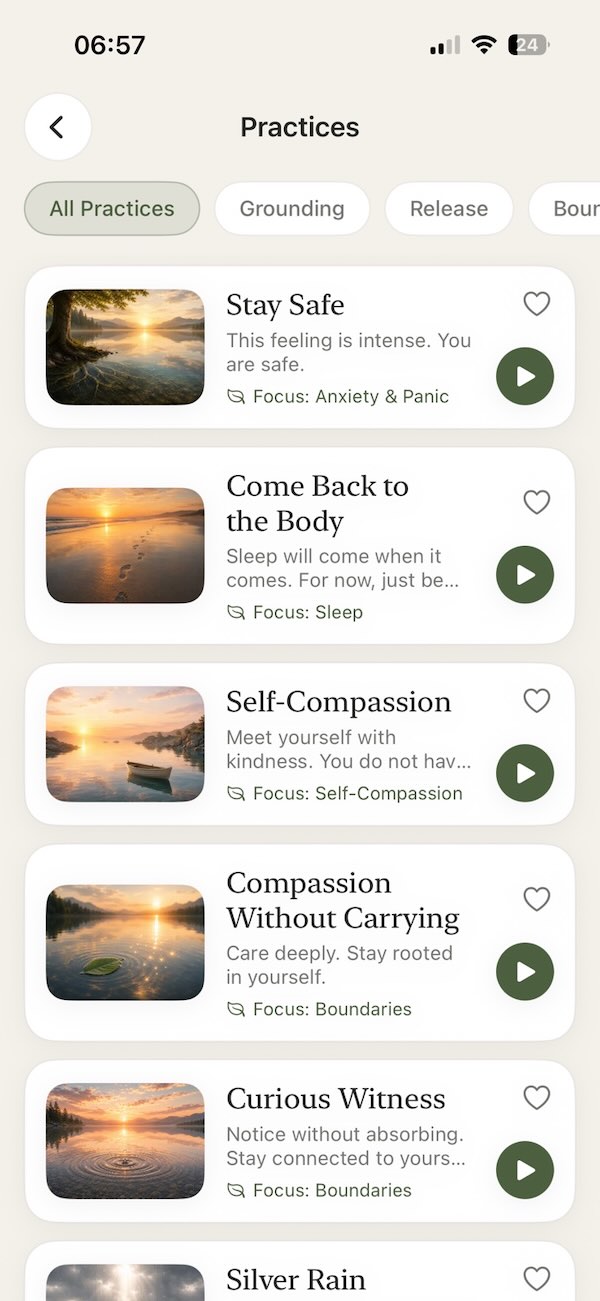
Keeping a trigger journal asks you to watch your own inner weather without getting swept up in it — and that's a skill you can build. Curious Witness is a gentle practice for exactly that: a way to step back and observe your thoughts and feelings with calm, non-judgmental curiosity, creating the small gap of awareness from which noticing your triggers becomes possible.

Try the practice
Curious Witness
Notice without needing to change.
Ready for more support?
Continue your journey in Aira
Access the full library of guided practices, tools, and resources anytime, anywhere.
- 10+Guided Practices
- AnxietyRelief Tools
- SleepSupport
- TrackYour Progress
- OfflineAccess
Available on iPhone and iPad