The Let-Down Effect: Why You Crash After the Stress Ends
Why you so often get sick or crash right after a stressful period ends — the let-down effect — what causes it, and how to ease the comedown instead of being flattened by it.

You push through the hard stretch — the deadline, the move, the exams, the crisis — running on adrenaline and willpower, holding it together right up until the moment it's over. And then, just as you finally get to relax, you fall apart. You come down with a cold, or a migraine floods in, or you're hit by an exhaustion and low mood that make no sense given that the hard part is done. If relief keeps arriving as a crash, you're not imagining it, and nothing is wrong with you. This is a well-recognised pattern called the let-down effect.
This is a guide to the let-down effect: what it is, why you crash after the stress ends, and how to ease the comedown so relief doesn't flatten you.
What is the let-down effect?
The let-down effect is the tendency to get sick or feel awful after a stressful period ends rather than during it. While the pressure is on, you often function surprisingly well — focused, capable, powered through. It's when the pressure lifts that the bill comes due: illness, headaches, fatigue, flatness, or a wave of emotion that seems to come out of nowhere. It's sometimes called the "post-stress" or "weekend" illness, because it so often lands the moment you finally get to stop — the Friday-night migraine, the first-day-of-holiday flu, the collapse after the big event.
Why you crash after the stress ends
There's real physiology behind this. Under sustained stress, your body runs on stress hormones like cortisol and adrenaline, which — among other things — keep you mobilised and can temporarily suppress or hold back certain functions so you can cope with the immediate demand. Your system is essentially deferring maintenance to get you through. When the stressor finally passes, those stress hormones drop, and the systems that were held in check come back online — sometimes with a rebound. That's when a lurking cold takes hold, inflammation flares, or the tiredness you'd been overriding finally catches up. The crash isn't the stress still hurting you; it's your body finally letting itself feel the toll it had postponed.
There's a psychological layer too. While you're bracing, you can't afford to fall apart, so you don't. The moment it's safe — when the pressure is off and you're allowed to stop holding it together — everything you'd been holding back can surface at once.
Why it feels so confusing
What makes the let-down effect disorienting is that it arrives exactly when you'd expect relief. You survived the hard thing; you should feel better, not worse. So when you crash, it's easy to feel like you're failing at rest, or that something must be seriously wrong. It helps enormously just to know this is a normal, predictable pattern — that the comedown is the natural other side of a big push, not a sign of weakness or a mystery illness. Your body kept its side of the bargain and got you through; now it's asking to recover.
How it connects to background tension
The let-down effect is really a concentrated version of something slower and quieter. When you brace for a long time — whether through an acute crisis or the low, constant activation of background tension — you build up a debt of unfinished recovery. A big, sudden release exposes that debt all at once as a crash. But the same debt can also drain out gradually as ongoing depletion if the bracing never fully lets go. Either way, the lesson is the same: sustained activation has to be paid back in recovery eventually, and the more braced you've been, the bigger the repayment. Understanding this makes both the sudden crash and the slow wear-down make sense.
How to ease the comedown
You can't skip the recovery your body is owed, but you can make it gentler. The most useful shift is to expect the let-down and plan for it, rather than scheduling something demanding for the moment the pressure lifts. Where you can, come down gradually instead of slamming from full-throttle to nothing — a taper is easier on the system than a cliff-edge. Build in real rest on the other side of a big push, and protect the basics that support recovery and immunity: sleep, food, gentle movement, water. It also helps to actively discharge the leftover activation rather than only collapsing — a slow exhale, a walk, time outside — so the brace can release cleanly. And perhaps most importantly, give yourself permission to feel wrung out afterward without judging it. The tiredness is the recovery happening, not a failure to bounce back.
When to seek support
If you crash hard after every stressful period, if you're getting sick often, or if the post-stress low tips into a depression or exhaustion that lingers, it's worth getting support. A doctor can check on the physical side — recurrent illness, run-down immunity, ongoing fatigue — and a therapist can help if the pattern points to living in near-constant stress with too little recovery. If you only ever feel the toll once you stop, that's often a sign the stretches between stressors aren't giving your system enough to recover. Taking that seriously is wise, not excessive.
Final thoughts
The let-down effect is your body being honest, just on a delay. It carried you through the hard part by postponing the cost, and the crash afterward is simply that cost arriving. Once you understand it, the collapse stops being frightening and becomes something you can plan for: expect the comedown, build in the rest, protect the basics, and let yourself recover without guilt. You're not failing at relief — you're paying back a debt your body was good enough to defer. One planned pause, one guilt-free recovery at a time.
Try a gentle practice
The let-down effect is your body asking to finally stop and recover — and the hardest part is often letting yourself. Permission to Rest is a gentle practice for exactly that: a reminder that you've done enough, that rest isn't something you have to earn, and that you're allowed to put down the weight and let your system replenish now that the hard part is over.

Try the practice
Permission to Rest
You've done enough. You're allowed to rest.
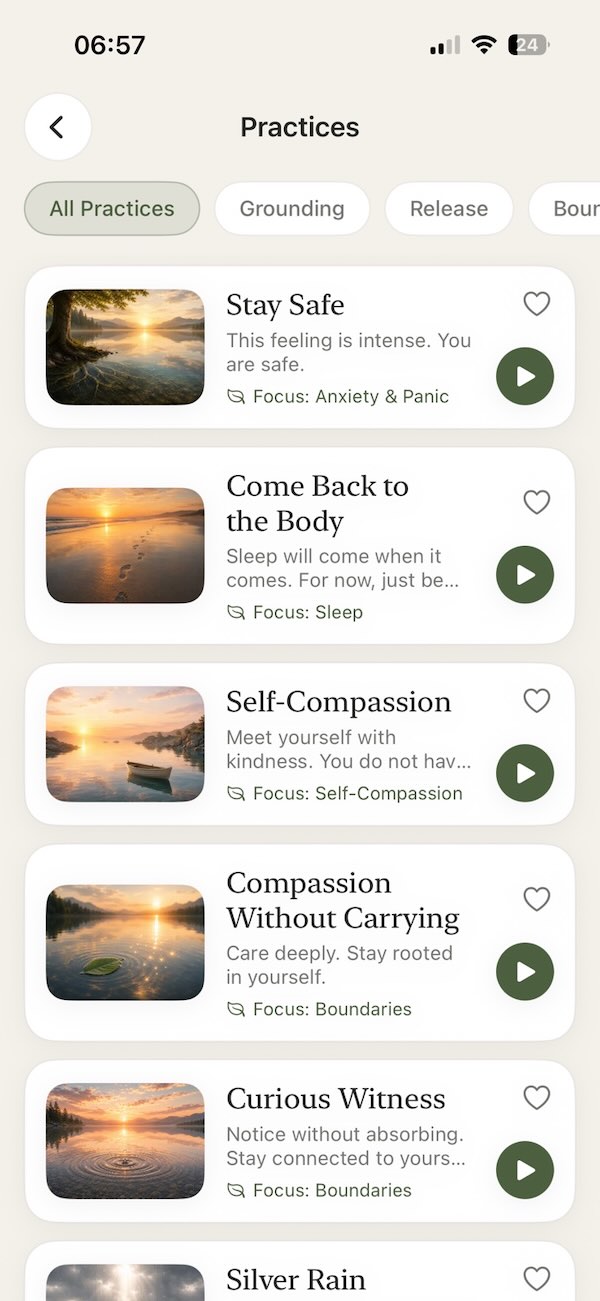
Ready for more support?
Continue your journey in Aira
Access the full library of guided practices, tools, and resources anytime, anywhere.
- 10+Guided Practices
- AnxietyRelief Tools
- SleepSupport
- TrackYour Progress
- OfflineAccess
Available on iPhone and iPad