Living With an Anxious or Chronically Tense Partner
Why living with a chronically anxious or tense partner keeps your own body braced, how their tension becomes yours, and how to stay steady without absorbing it or abandoning them.

When you share your life with someone who is anxious or tense much of the time, their state doesn't stay on their side of the room. It seeps into the air you both breathe. You find your own body braced, your own sleep lighter, your own mood shadowed — not because anything is wrong in your day, but because you're living inside someone else's activation. If you love someone whose default is stressed, and you've noticed you can't quite relax while they can't, this is why — and there are things you can do that help both of you.
This is a guide to living alongside a chronically tense partner: how their tension becomes yours, why you can't simply relax through it, and how to stay steady without absorbing it or abandoning them.
When their tension becomes your tension
Nervous systems are not sealed off from each other — they're constantly reading and responding to the people closest to them. Live beside someone who is chronically braced, and your system starts to mirror theirs: a little on guard, a little ready, tuned to their mood the way you'd stay tuned to weather. This is emotional contagion, and it's strongest in the closest relationships. You didn't choose to take on their tension; your body did it automatically, because staying attuned to a partner is exactly what bodies are built to do.
Why you can't just relax when they can't
People often wonder why they can't simply decide to be calm regardless of their partner's state. The answer is that your nervous system is looking to the environment for its cues of safety — and a key part of your environment is the person beside you. When they're relaxed, your system reads safe and settles. When they're braced, it reads something's wrong and stays ready, even if nothing is actually happening. You can't fully talk yourself out of this, because it's running underneath thought. Their unrest becomes a signal your body keeps responding to.
The cost of living braced alongside someone
An occasional tense evening is nothing. But when the tension is the daily backdrop, the effect accumulates. You start bracing all the time; you sleep worse; you become watchful of their moods — anticipating the next bad mood, tiptoeing to avoid setting it off, monitoring the door and the silence. Over time this is genuinely depleting, and it can quietly tip into a fearfulness of its own: afraid you won't sleep, afraid of the next flare, worn thin by a vigilance you never signed up for. And there's a cruel loop in it — as you fray, they may become more anxious about you, which raises the tension further. Naming this clearly is the beginning of stepping out of it.
How to stay steady without absorbing it
The most important shift is to stop trying to relax them into calm and start protecting your own steadiness — because, counter-intuitively, your steadiness is the most helpful thing you can offer. A regulated nervous system beside a dysregulated one gives it something to borrow; two activated systems just amplify each other.
Begin with separation: when you feel the tension rise, ask whose is this? Recognising their state as theirs keeps you from wearing it as your own. Then hold your own line — you can care about your partner's stress without making it your job to fix, absorb, or defuse every time. You are allowed to stay calm while they are not; that isn't coldness, it's ballast. Protect the basics that keep your baseline steady, especially your sleep, even when that means a different room or a firmer boundary around your evenings. And discharge what you pick up — a walk, a long exhale, time in your own space — so their activation doesn't set permanently in you. Supporting a partner and dissolving into their state are different things; the first helps, the second helps no one.
When it's more than tension
Sometimes what's being described isn't just a stressed partner but a dynamic that's genuinely harming you — where your health, sleep, and sense of self are eroding and boundaries aren't respected. If that's the case, it deserves more than coping strategies. It's worth being honest with yourself about the difference between this is hard and workable and this is wearing me down in ways I can't sustain. You don't have to decide anything alone or overnight, but you're allowed to take your own wellbeing seriously, and to get outside support to help you see the situation clearly. Caring for someone never requires the steady loss of yourself.
The fuller picture
Underneath the strain is often one belief: if I love them, I have to carry their tension with them — and I can't be okay while they're not okay. It feels true because staying braced alongside them looks like solidarity, like proof you're in it together.
But matching their activation isn't solidarity — it's just two people wound tight instead of one. Your tension doesn't lift theirs; it removes the one steadying presence in the room. The most loving thing you can offer a stressed nervous system isn't a second stressed nervous system — it's a calm one to borrow from. And being okay while they're not isn't betrayal or indifference; it's what keeps you intact enough to actually be of use, rather than going under with them. You can love someone completely and still keep your own baseline. In fact, keeping it is often the best thing you can do for them — and it's the only version of this that doesn't slowly erase you.
When to seek support
If living with your partner's tension is steadily wearing down your sleep, your health, or your sense of who you are — or if you can't find your own footing no matter what you try — please consider getting support. A therapist can help you build the internal boundary that lets you love without merging, support without carrying, and can help you look clearly at what's workable and what isn't. Couples support can help too, when both people are willing. You don't have to hold this alone.
Final thoughts
Loving a chronically tense partner is genuinely hard, and if you've been quietly bracing alongside them for a long time, the toll you feel is real and makes complete sense. The way through isn't to care less or to force them calm — it's to protect your own steadiness, because that steadiness is both what keeps you whole and the most useful thing you can offer them. You are allowed to be okay while someone you love is struggling. That isn't abandonment; it's ballast. One whose is this?, one protected night's sleep, one held line at a time.
Try a gentle practice
Staying steady beside someone else's tension means holding your own ground without hardening against them. Hold the Line is a gentle practice for exactly that — a way to stay rooted and calm in your own body while another person is activated, so you can stay caring and connected without being pulled into their state.

Try the practice
Hold the Line
Stay steady when you hold a boundary.
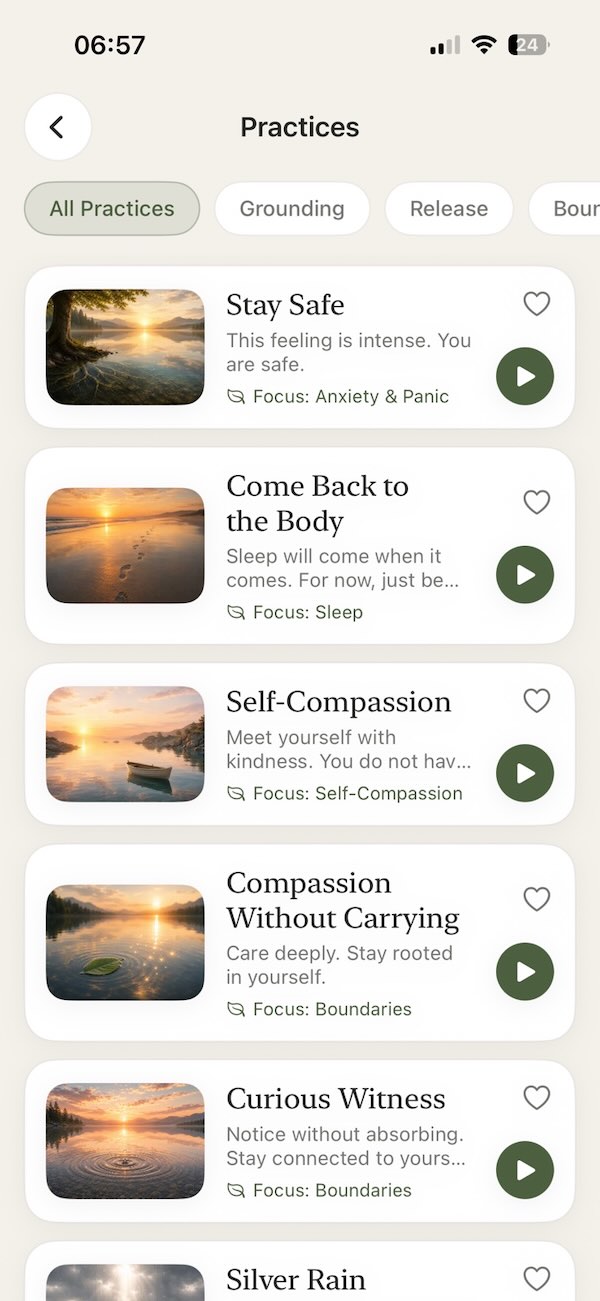
Ready for more support?
Continue your journey in Aira
Access the full library of guided practices, tools, and resources anytime, anywhere.
- 10+Guided Practices
- AnxietyRelief Tools
- SleepSupport
- TrackYour Progress
- OfflineAccess
Available on iPhone and iPad