Why You're Suddenly Sensitive to Noise, Light, and Everything
Why chronic stress can make you suddenly sensitive to noise, light, and stimulation, why everything feels like too much, and how to bring an overloaded system back down.

Sounds feel too loud. Lights feel too bright. A busy room, a strong smell, a bright screen, someone talking nearby — things that never used to bother you now feel like too much, sometimes almost unbearable. If your senses have turned up to a volume you didn't ask for, and you can't understand why everything suddenly grates, you're not imagining it and you're not being dramatic. This is a real and well-recognised effect of a nervous system under sustained stress.
This is a guide to that heightened sensitivity: what's happening, why stress turns up the volume, why it can appear seemingly overnight, and how to bring your system back down.
What's happening: a sensitised nervous system
When you're under chronic stress or anxiety, your nervous system shifts into a heightened, watchful state — and part of that is turning up the sensitivity of your senses. It's doing this on purpose: a system braced for threat wants to detect everything, so it amplifies incoming signals. Sound, light, touch, smell, even internal sensations all come through louder and sharper. The result is that ordinary input starts to feel like too much, because your system is processing it as if it might matter, might be a threat, might need a response. You're not more fragile; your volume dial has been turned up by a system trying to keep you safe.
Why stress turns up the volume
This heightened sensitivity is closely tied to hypervigilance — the state of scanning for danger that a stressed system falls into. When your system is on alert, it can't afford to filter things out the way it normally would, so the usual background hum of the world stops being background. The filtering that lets most people tune out a flickering light or a droning noise gets switched off, and everything competes for your attention at once. Add tiredness and depleted reserves, and there's even less capacity to buffer input, so the same amount of stimulation lands harder. It's a system doing too much processing with too little left in the tank.
Sensitivity as a state, not just a trait
It's worth naming the difference between being a highly sensitive person and becoming suddenly sensitive. Some people are wired, lifelong, to process more deeply — that's a stable trait. What we're describing here is different: an acquired, state-based sensitivity that shows up when your system is stressed, overloaded, or depleted, and that wasn't there before. That distinction matters because it carries good news. A sensitivity that arrived with stress can ease as your system settles. It's not a permanent change to who you are; it's a signal that your system is overloaded, and signals can quiet down once the load lifts.
Why it feeds background tension
Heightened sensitivity and background tension reinforce each other. A braced system amplifies input; amplified input keeps the system braced. Every jarring sound or harsh light is one more small hit of activation, and across a day they add up, keeping you wound and depleted. This is why sensory overwhelm so often travels with that low, constant tension — they're two faces of the same over-activated state. Which also means that calming the system and reducing the input work together: turn down one, and the other has a little more room to settle too.
How to turn the volume back down
The approach is twofold: reduce the load coming in, and help the system that's amplifying it to settle. On the input side, lower your sensory exposure where you can — quieter spaces, softer light, fewer things happening at once, breaks from screens and crowds. This isn't avoidance or weakness; it's giving an overloaded system less to process while it recovers. On the system side, the deeper work is calming the overall state of activation — through rest, slow breathing, gentle movement, protected sleep, and the same nervous-system care that eases background tension generally. And it takes patience: a sensitivity that built up under months of stress settles gradually, not overnight, as your baseline comes down. The goal isn't to force yourself to tolerate more; it's to lower the volume at the source.
The fuller picture
Underneath the overwhelm is often a frightening belief: something is wrong with me — I've become fragile, broken, unable to cope with normal life. It feels true because the sensitivity is so physical and so sudden, and because the people around you don't seem to struggle with the same things.
But a sensitised nervous system isn't a broken one — it's a working one, turned up too high. Your system amplified your senses on purpose, because under sustained stress its job is to detect everything that might matter; the overwhelm is that safety mechanism running too hot, not a defect in you. And because it's a state, not a permanent rewiring, it can come back down as the load eases — which is exactly why this so often lifts as people recover. So "I can't handle normal life anymore" isn't the truth of it; "my system is overloaded and turning everything up" is, and that's a far more hopeful and accurate reading. You don't need to toughen up or override your senses. You need to lower the load and settle the system, and the volume comes down on its own.
When to seek support
If the sensitivity is severe, if it's making daily life hard, or if it comes with other symptoms that worry you, it's worth checking in with a doctor — heightened sensitivity to light or sound can have other medical causes worth ruling out, and it's sensible to be sure. A therapist can help with the chronic stress or anxiety underneath a sensitised system. Taking this seriously isn't overreacting; a system this overloaded deserves support.
Final thoughts
Becoming suddenly sensitive to noise, light, and everything isn't a sign that you're breaking — it's a sign that your nervous system is turned up too high, doing too much processing under too much load. That's uncomfortable, but it's also workable and, importantly, reversible. As you lower the input and settle the system underneath, the world stops feeling quite so loud, quite so bright, quite so much. Your senses aren't the problem. They're just waiting for the volume to come back down. One quieter hour, one softer moment at a time.
Try a gentle practice
When everything feels like too much, the instinct is to brace against it — which only keeps the volume high. Soften is a gentle practice for exactly that: a way to release the bracing, let go of what doesn't need your attention, and ease an overloaded system down out of high alert, so the world can stop feeling so overwhelming.

Try the practice
Soften
Let's release what you are holding
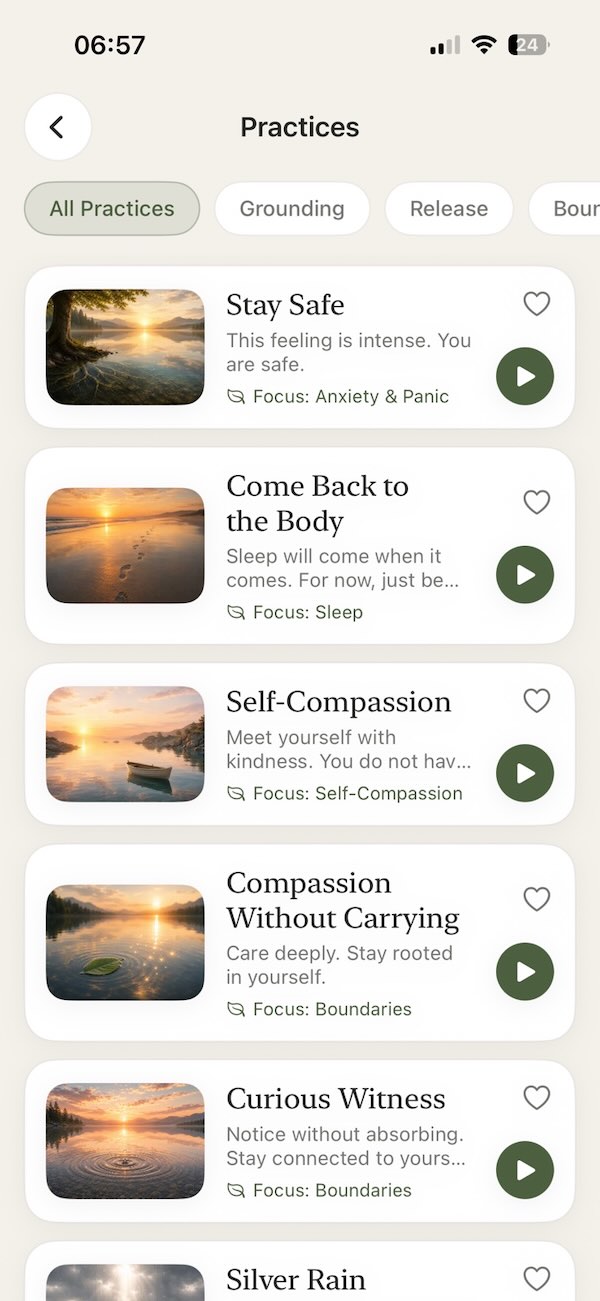
Ready for more support?
Continue your journey in Aira
Access the full library of guided practices, tools, and resources anytime, anywhere.
- 10+Guided Practices
- AnxietyRelief Tools
- SleepSupport
- TrackYour Progress
- OfflineAccess
Available on iPhone and iPad